
As your civilisation meanders through the ages, how will the decisions its people make affect the future? How can what we do now ensure the brightest outcome for our descendants? How can we make sure we, the beige civilisation, gets the most points? Everyone knows that over the Millennia, only your progress on the Tracks of Time will tell who has won at civilisation.
1-4 Players | 1-2 Hours | Designed by Mike Georgiou and Orestis Leontaritis
Millennia: Tracks of Time is a new game from publisher Karma Games (you might remember them as the publisher of Clans of Caledonia). Recently Karma Games has released a couple of new games along with an expansion for Clans of Caledonia. Millennia: Tracks of Time is a great name for a game because it includes a bit of a pun – so I’m instantly on board. Currently Millennia is ‘released’ but only being sold via the Karma Games website, with a retail release hopefully coming soon!
How does it work?
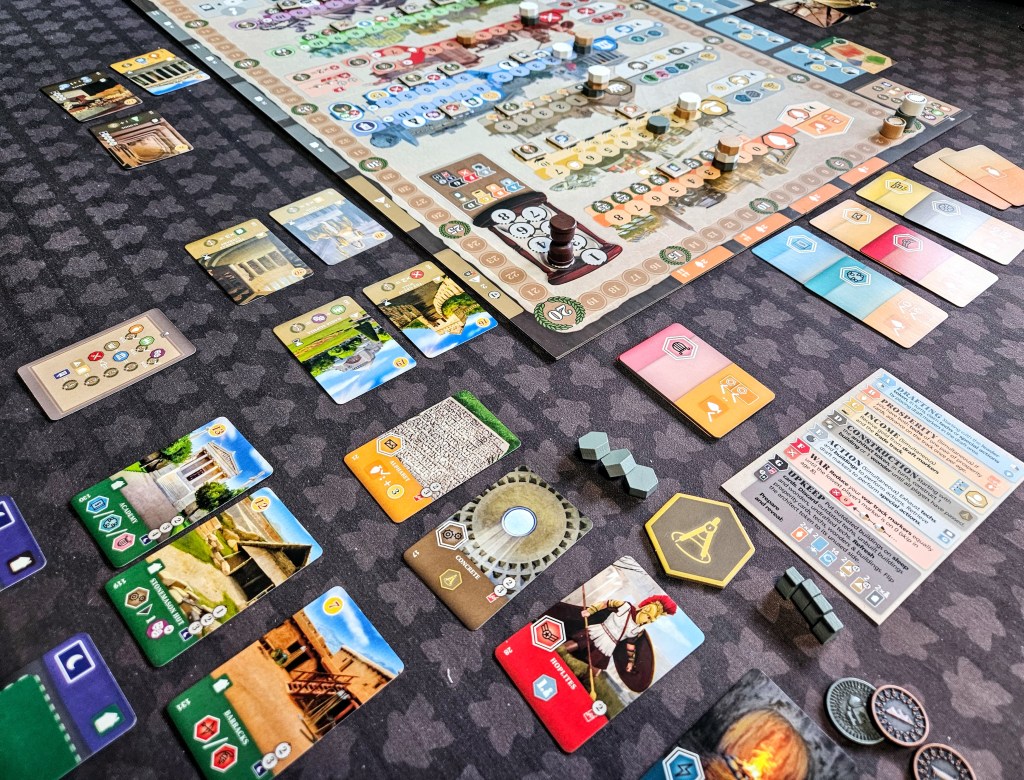
In Millennia: Tracks of Time, players play through 8 eras of civilisational development. In each round players will draft technology cards, buy building cards, and then spend the resources they have available to them to progress their civilisation’s stats on the various tracks in the game.
At the beginning of each round a new set of technology cards and building cards are set out according to the current round. Players then make use of up to 4 actions to draft technology cards (which primarily provide a resource, 1 of 14 types) or reserve powerful actions to use during the action phase later. Once drafting is complete, player may gain ‘prosperity’ if they have drafted cards matching the current prosperity bonus criteria, which essentially earns end-game points.
From here, players will earn income (based on where they drafted cards from, and their trade stats) and then use the money earned to buy building cards in turn. Buildings do a few different things, provide resources, provide actions or action bonuses, or give points at the end of the game. There are also more expensive wonders available each round that add scoring conditions to a player’s end game.
Players now will have the opportunity to spend their resources to advance on the tracks! Each track requires a different combination of resources (gained by tapping tech cards or some buildings) to move up. Why do you want to move up on tracks? Each track has a different reason. The trade track increases your income, the civic and influence tracks offer big end game scoring, the military track lets you score points during the game, the food and population tracks give benefits to other tracks and the culture track gives you flexibility everywhere else.Tracks also have various bonuses along them that give scoring or combo actions.
There are a few other elements to the game like the research system that lets you unlock passive abilities, diplomacy that gives you powerful one-time-use powers, and wild tech cards that you can spend as any resource.
The buildings available in each round evolve as the game progresses and players are also faced with a constantly declining ‘engine’ as most cards in the game expire after a few rounds. This means planning and replacing parts of your civilisation is key to keeping things turning and ending up the civilisation with the most points after the 8 ages!
What do I think?
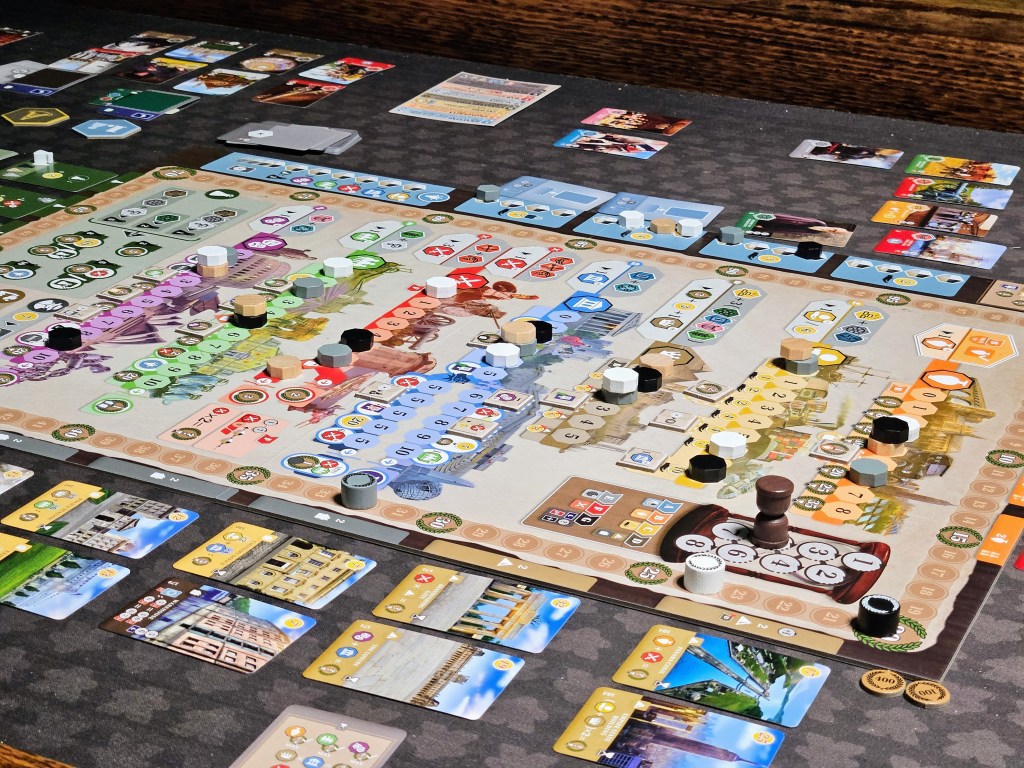
I’ve played Millennia: Tracks of Time four times now and it has left a great impression on me. The game feels like a ‘meaty’ civ game but the rules are simple and the game is very streamlined. Playing with 3 or 4 players I found the game to have a lot of competition between players in the draft and building rounds. I’m not sure how great these elements would be with two players and I also wonder if the game would feel less ‘tense’ or ‘challenging’ as you would likely be able to draft a lot more of what you wanted.
The Good Stuff
- The rulebook for Millennia is well laid out, clear and the rules are pretty smooth and straightforward. I had no trouble with learning and teaching, and the included player aids are fantastic, they lay out the flow of each round with enough detail not to really need to refer to the rulebook.
- Card and component trays super useful especially for speeding up setup of game and refreshing cards each round.
- Having specific cards for each round/era means that the game progression is well controlled by the designer and it feels good. Things get bigger and better as you go and time moves on
- The drafting is the main point of player interaction on this game and it is a very tense phase with a lot of conflicts! It’s basically a given that other players will take the things you want between your turns so you need to be ready to pivot and adjust your strategy as this phase progresses. It can be very important to be start player or architect (building start player)!
- This game has combos and while it’s not crazy like some games you can certainly have some satisfying turns where a lot of stuff happens thanks to chaining your cards, track bonuses and research.
- Millennia has a really good ‘civ game feel’ – you really get the sense of guiding and developing your civilisation through the ages and ending up with something great (or not!) at scoring time.
- The graphic design and theming is well done in this game! I didn’t have any issues with icons or UI elements and I enjoyed the progression through the ages and into the future.
The Bad Stuff
- There are moments in this game that can generate AP (Analysis Paralysis) and leave you stalled for a bit. In the drafting cases, usually there are enough similarly good options for you to take you can make a decision quickly. I found that during the Action round I could really spend some time figuring out what I wanted to do and in what order. This round is simultaneous so technically you are only holding people up if you take the longest to do this and we were usually all finished around the same time so that was ok with my group. But this is certainly a game where you are presented with a breadth of options.
- While this is one of the things that makes the game so great … I just always feel disappointed when it comes time to hand over my expired cards. Sometimes you are left with very little (a sign of bad planning?) but that is the very nature of this game.
- With no turns in the Action round it can become a bit chaotic. You need to be pretty careful to keep track of what you are doing, making sure to spend cards etc and not get confused about where you are up to. We played the first round one player at a time to help guide new players through this process the first time to help with this.
- Research to me just feels a bit blah, like it’s a bit of a half baked mechanic. Research should be exciting and powerful! I shouldn’t just want to pick the points option! In another realm my hope would be for this to generate some sort of technology modifier cards.
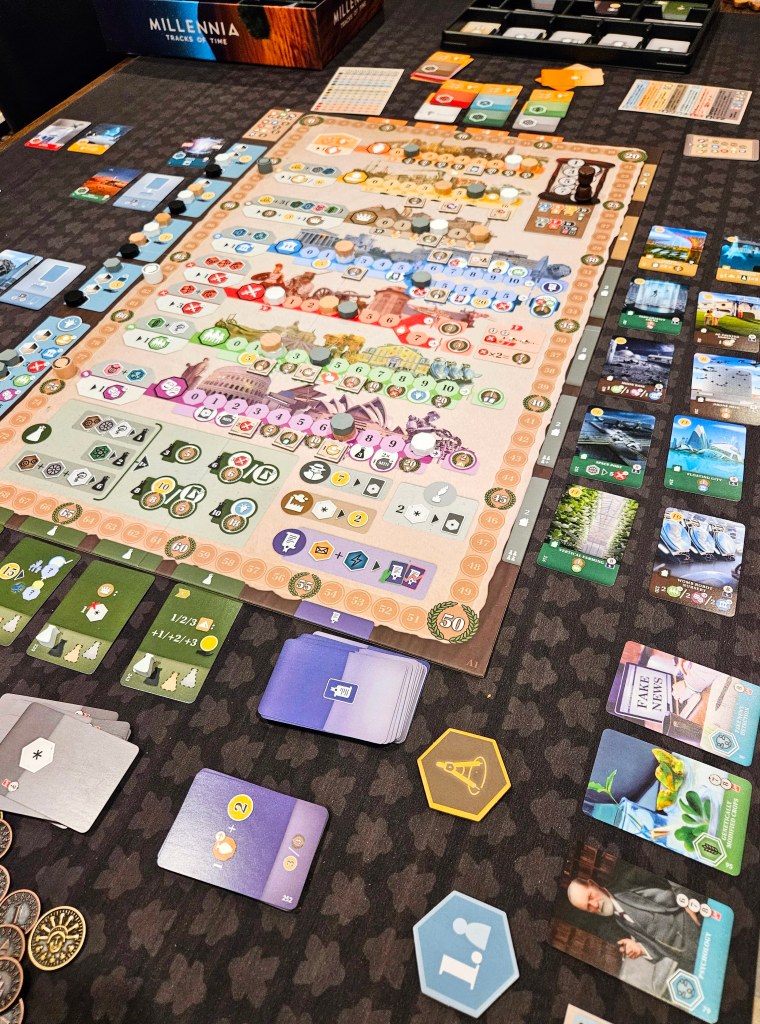
Millennia: Tracks of Time is one of those games where you can’t do everything and so when you get to the end it gets you thinking “What if I did this instead?” – better play again! I really enjoy pretty much everything about this game. Lots of interesting decisions, tension between players, and it’s very smooth to play. I wish this game was on BGA because I think it’s a perfect fit for the platform and the turn-based play style. As it stands, I highly recommend Millennia if you like drafting, engine building (and maintenance), and tracks! If you’re interested in finding out more or picking up a copy, head over to the Karma Games Store to check it out!
The copy of Millennia: Tracks of Time used for this review was provided to The Boardgame Detective by Karma Games


