


Wow, what a great time I had at PAX Australia 2026! This year PAX banished TTRPG to a hall upstairs and so there was EVEN MORE space for Boardgames! I took the opportunity to experience some unreleased designs that people had brought to PAX to test and spruik. Of course, PAX is huge, and there were SO many games being play-tested in the ‘Collaboratory’. I also checked out some indie games, however I have been somewhat distracted by Pin collecting at PAX… maybe soon I will switch to coverage of Pinny Arcade 😅
The Collaboratory
Designers can book slots to show off their designs in the PAX Collaboatory, a sea of tables you can wonder and discover new ideas. Here’s what I found when I was there:
Aethermon Mosaic
The Aethermon team are no strangers to PAX, having been found over the last few years in both the Collaboratory and Indie Showcase/PAX Rising with their game Aethermon Collect. Aethermon Mosaic is a game set in the legally distinct world of Aethermon, and while you might think it looks almost the same (square cards laid in a grid) as Collect, the game is quite different. It’s almost like a dominoes style game. I got to chat with designer Chris and play against designer Sarah and a few others.
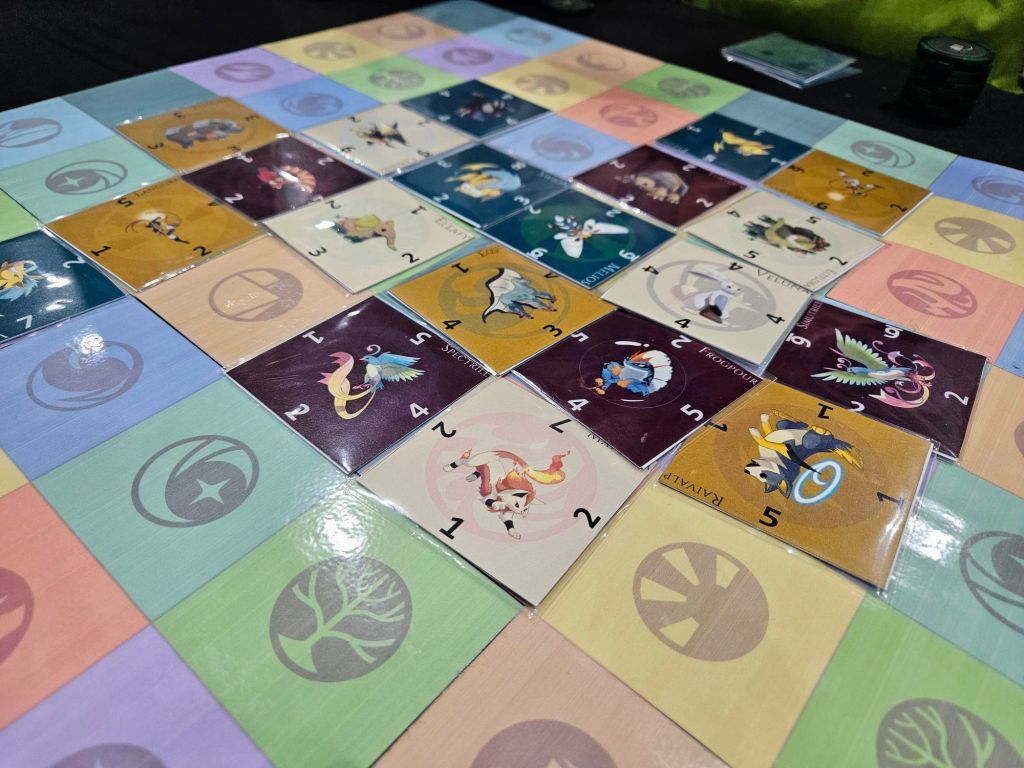
In Aethermon Mosaic, each player has a unique deck of Aethermon cards. The decks are roughly balanced but each contain different types (which matters for matching the terrain on the board). To begin players draw a hand of 3 cards and then take turns adding their Aethermon to the board. Cards must be played adjacent to existing cards. Once your card is placed, scoring takes place. Cards have numbers around the outside,and when a new card is added to the board, all newly created number pairs are checked, with the player owning the higher number in each pair gaining a point. You also gain a point if the card you just played matches the terrain it was placed on. Typically players are looking to score 2-3 points per placement, but occasionally big turns could yield 4 or even 5 points! In my game it was very rare that anyone scored points from another players card placement but it did happen occasionally. The game finishes when all players run through their decks (The board is maybe 2/3 full at this point)
I found Aethermon Mosaic to be a quick, puzzly and fun take on tile laying. I’m not super sure the theme really meshes great with the gameplay mechanics but a lot of effort has gone into creating a vibrant world. If you are keen to follow along, check out the Aethermon website where you can play their previous game Collect and keep an eye on updates for Mosaic!
Hyperspace Panic
Hyperspace Panic is a 1 v 1 battle cardgame. Players take control of a spaceship and crew, training up their crew members into speciality roles and slinging damage at their opponent until one ship is destroyed.
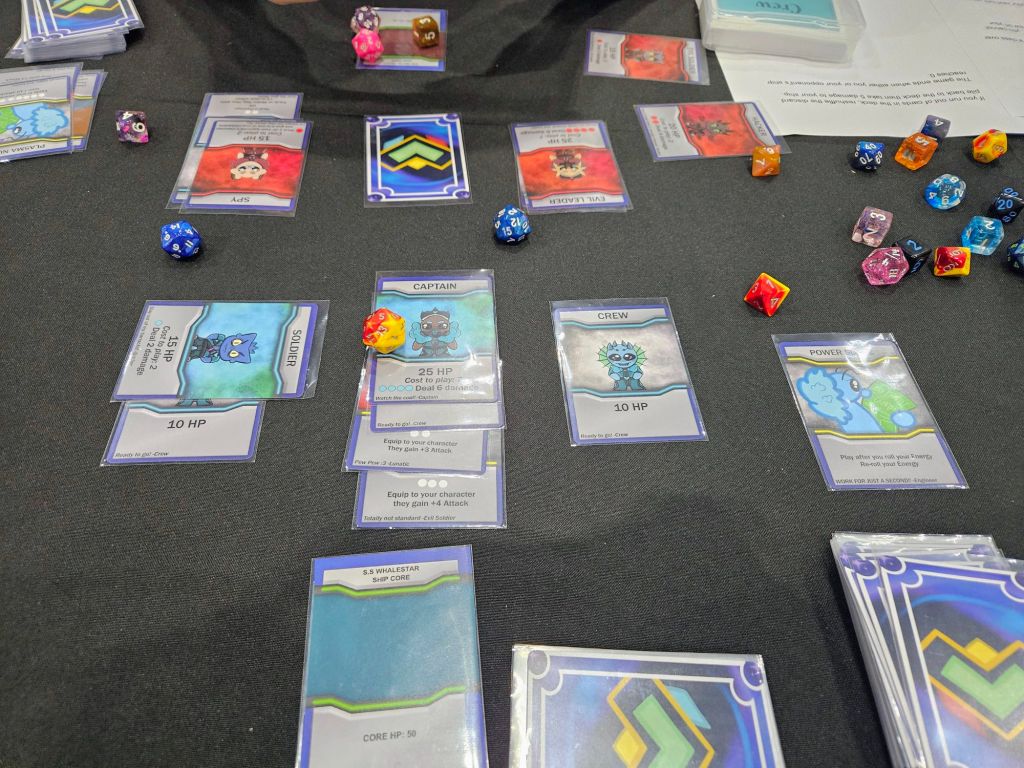
Gameplay follows along largely with TCG or other battle cardgames. The big ‘twist’ (for me) was that on your turn to determine how much energy (mana) you have to do actions you roll a d8. You then have 1-8 energy to spend on various actions, which include upgrading your crew members from basic to specialised roles (that can do damage, or have other powers), add weapons and other accessories to the crew, or play event cards that do something to you or your opponent. The object of the game is to batter your opponents ship HP to 0, but before you can attack the ship directly you need to make a hole in the player’s defence by taking out at least one crew member. Turns flow pretty quickly and there is a fair bit of strategy involved.
Thanks to the designer whom with I played the game giving me a bunch of tips on ways I would make my way through their defences, I was able to edge out a victory in the game. I understand the excitement and novelty of having a ‘random’ amount of energy with which to allocate to actions each turn, but I rolled A LOT of 1’s and found it quite frustrating to have several of my turns be essentially passing. I did suggest an possible alternative to this and the designer seemed receptive to the idea – being able to discard cards from hand to gain 1 extra energy on turns when energy was short. Overall, while this isn’t my sort of game I feel like it would fit well as a casual substitute for more time consuming and $$ TCG games while giving a similar 1v1 feel. If you are interested in following along with the development, checkout the Hyperspace Panic Instagram page.
The Great Blood Hunt Dance of Death
Zombies! No wait… Vampires! The Great Blood Hunt is a sort of social deduction game where players fight over villagers for the ones with the tastiest blood. While the name is certainly a mouthful, the gameplay is simple and quick! Ben took us through a game with 4 players, quickly teaching us rules and having us playing in a couple of minutes
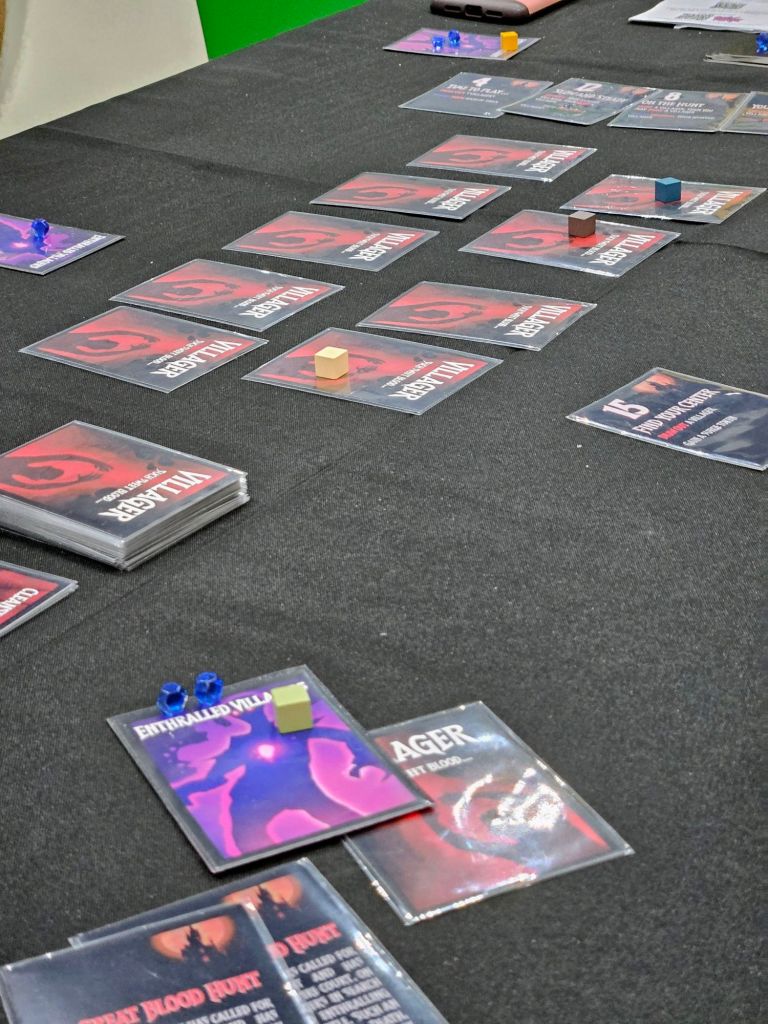
Players all assume the role of Vampires hanging around a local village, looking to “enthral” the villagers with the most interesting blood (and thusly the most interesting points values). On your turn you play one of the three action cards from your hand. These do various things such as adding new villagers to the pool of available victims (these are all facedown), letting you peek at a villager, letting you set your targets on someone or perform the “enthral” action which lets you harvest that villager. All of the villager cards have scoring conditions and points on the back of them – but you can’t normally see them. If you get a chance to peek at one it’s up to you to remember what it was (and if it was good try to enthral them). After each turn you put the card you just played into the card market and pick one of the other few cards there to add to your hand of actions. Play continues until the village stocks are depleted and then the player with the most points wins.
While I largely enjoyed the gameplay of The Great Blood Hunt, memory games are one of my least favourite mechanics. Despite this, because the game has mechanics that allow you to ‘steal’ villagers other players have marked for themselves, you have a chance to rely on other people’s memory (or suffer from their bluffs). There were a few entertaining moments where poorly masked disappointment led to further points losses. If you want to keep tabs on The Great Blood Hunt or checkout other games from Ben, you can visit the Pink Wizard Games website!
Boulder Dice
Boulder Dice was a game that drew me in with table presence. After I sat down though I had another look and was a bit puzzled as the board looked like a very basic roll and move game. As the designers introduced the game concepts and mechanics though I got very excited! I LOVE dexterity games… and this is a one with some very interesting twists indeed!
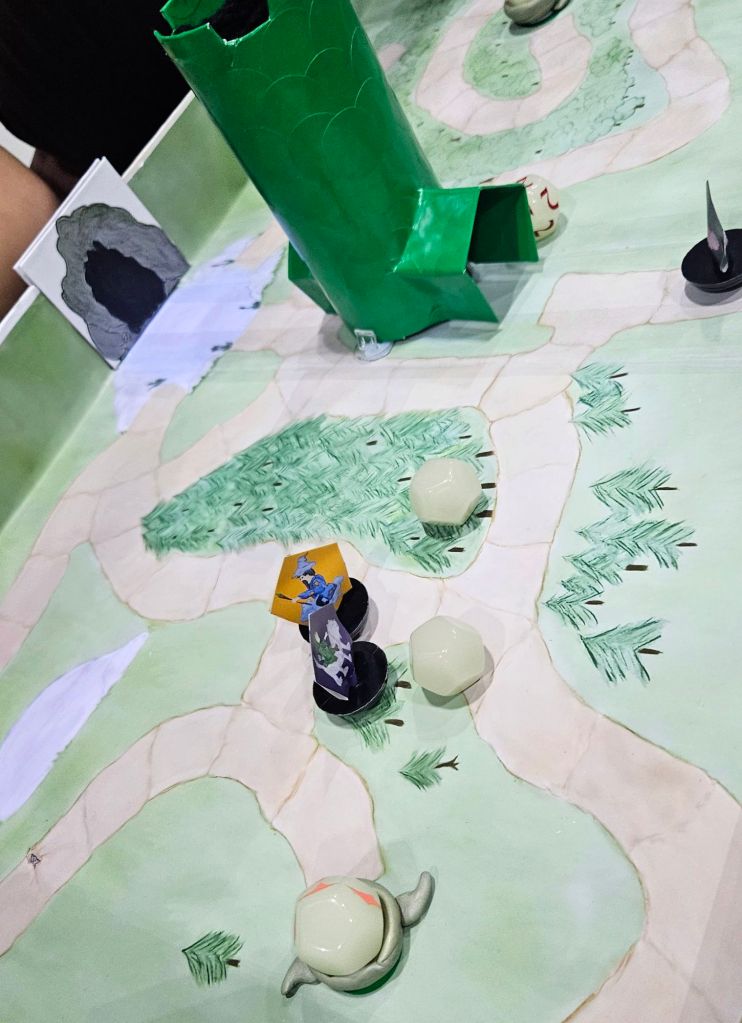
Boulder Dice IS a roll and move game with a very healthy dose of chaos added. Players take turns rolling their dice to try and gather up (or steal!) three “infinity stones” before the other players, and then return to the green tower to win the game. Each player starts the game with 3 dice, 2 blank and one numbered. All dice are rolled within the ‘arena’ one at a time, with the numbered dice face result allowing you to move your player piece a number of spaces along the paths. But here is the fun bit! You are allowed to roll your dice into your and other players pieces to try to knock them around! For your piece this means taking (attempted) shortcuts to your goals, and when you’ve achieved what you want to on your turn, it means messing up other players plans by knocking their piece into the wilderness! Players starting their turn off the path must endure an encounter. Getting to the ends of paths allows you to pick up the coloured dice, increasing your arsenal and getting you closer to winning, and finally… if you run into another player you can duel them for a dice!
I was so impressed by Boulder Dice, it was my standout game of the convention. It has many rough edges still, but it such a promising concept, and it seems so obvious but I’ve never seen the concept before. I’m really excited to see where this game goes, I’ll certainly be following along at the Tina Dee Games Instagram.
Alien Afterparty
After sitting for a few minutes and staring at the designer of Alien Afterparty‘s face I finally realised where I recognised them from – Spellwards! A game that I had played with them at the Collaboratory several years earlier, and since had several more very stressful game sessions at home with the game after the Kickstarter delivered. Of course, that both made me excited to dive into Alien Afterparty, and anxious that it would result in similarly stressful situations as Spellwards created. Alien Afterparty takes place after several groups of aliens have simultaneously invaded earth, killed all (most) of the humans, and are looking to blow off steam a series of parties taking place after the invasion. I’m happy to report that I survived the Afterparty.
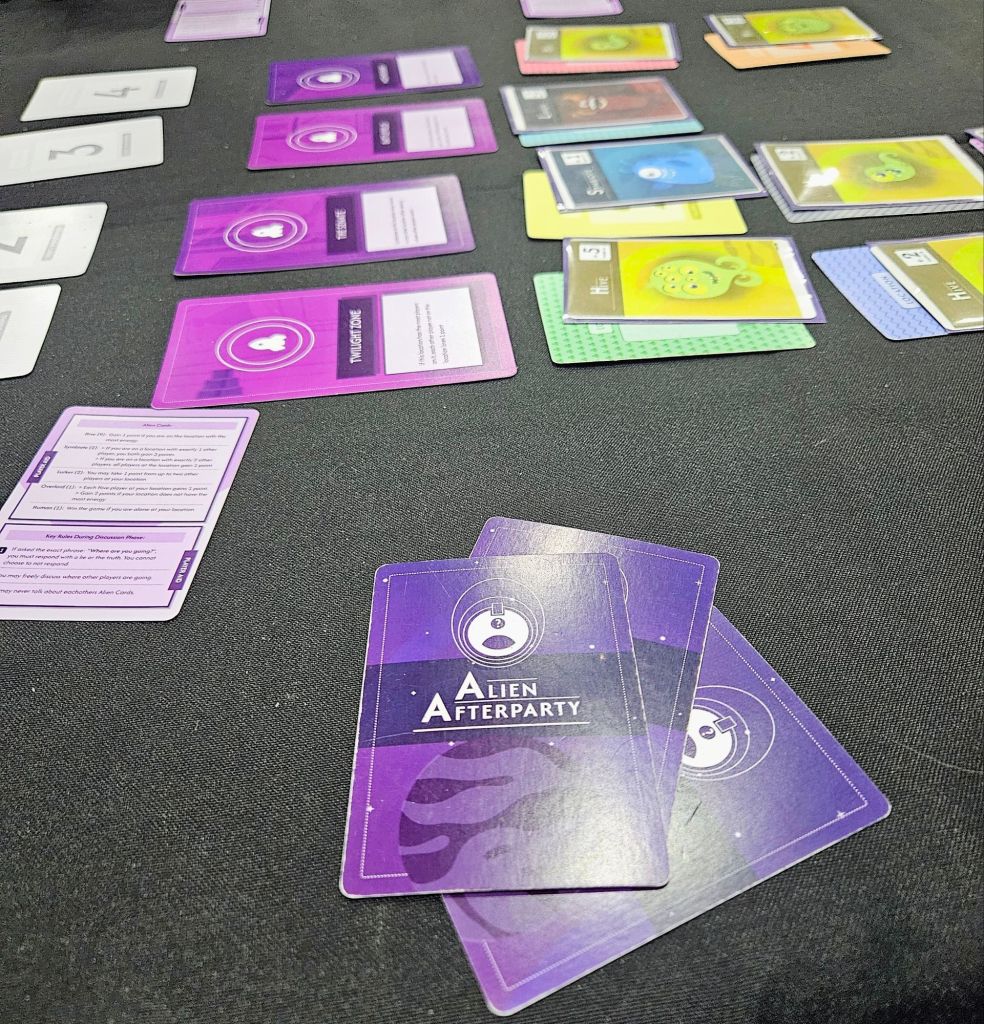
We played the game with 8 players. Over 3 rounds players get assigned their alien species in a celebrity heads style (you wear the card on your head and don’t get to see it). Then it’s up to players to decide which of 4 parties they would like to go to. You get points based on the other attendees at the party you go to so you want to encourage certain players to go to parties with you, but without being certain who you are you can never really know what might happen. The major thing to look out for is that one human has survived the preceding massacre, and if they manage to go to a party all on their own, they win – otherwise after 3 rounds whoever has the most points wins the game.
I think that Alien Afterparty is a great and funny concept, I just felt while playing it that some small element was missing.Without being able to have any certainty about my card, I didn’t feel like I could form a strategy. But I also acknowledge I was playing my first game, I would expect with a little bit of experience in a group, the game might reveal reasons and subtle mechanisms for why doing certain things makes sense. Overall, this is a pretty cool game, I’m excited to see where it goes from here! You can follow Thiens’ Instagram here if you are interested too.
Counter
Have you ever worried that regular blackjack doesn’t have enough maths? Or that it doesn’t have enough attacking other players? Or that it doesn’t have enough resurrecting from busting? Well… have I got the game for you! Counter! Counter‘s tagline is “Learn maths, lose friends”. I certainly struggled with the maths part and I also struggled with losing friends while playing (I’m not usually a very mean player!). But I had a lot of fun!
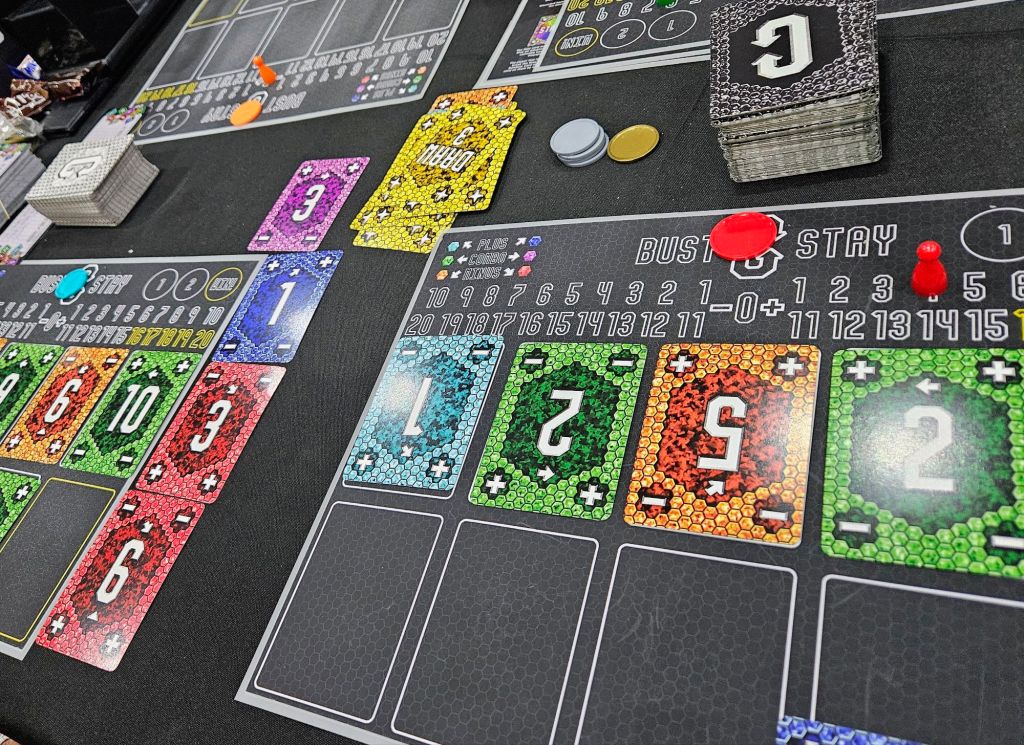
Counter is a card game that does indeed play pretty similar to blackjack. Players are trying to be the first to get in to the 15-20 card total range and “win” if nobody beats them on that round. On your turn you hit a card off the deck which you add to your tableau, updating your running total depending on if it’s a negative or positive number. Some cards allow you to play them onto other players, adding or subtracting to their totals, and often you will draw a ‘Flip’ card from the deck, which turns all your cards upside down and inverts your score (e.g. +12 goes to -12!). On top of this, players begin the game with a small hand of special cards they can play in addition to their ‘hit’ card each turn, allowing for surprise jumps, last minute save-from-busts and other shenanigans.
Counter gameplay is wild and game can vary so much because there are so many different types of cards. It’s entirely possible a game could be won on a first turn if you drew the 20 card and nobody could beat you or mess you up, but usually there is a bit more strategy and tactics involved in a win. I was pretty impressed with the design, although I did find the cards look too symmetrical, and relying on colours for which cards could be played where took a while for me to grasp. I can see this being a great quick party game, or a fun learning tool for school age groups of kids! Counter has an Instagram account you can follow for updates.
HexIron: Cast Your Shells
Have you ever thought that you really like the composable gun system from the Borderlands series of games but always wished that it was the core mechanic of a boardgame and that you then used your constructed gun to duel it out against the other players of that game? Yeah? You’re in good luck then! HexIron is pretty much exactly that. Oh and also you are all Witches. Witches duelling with guns made from composable parts. Yes!
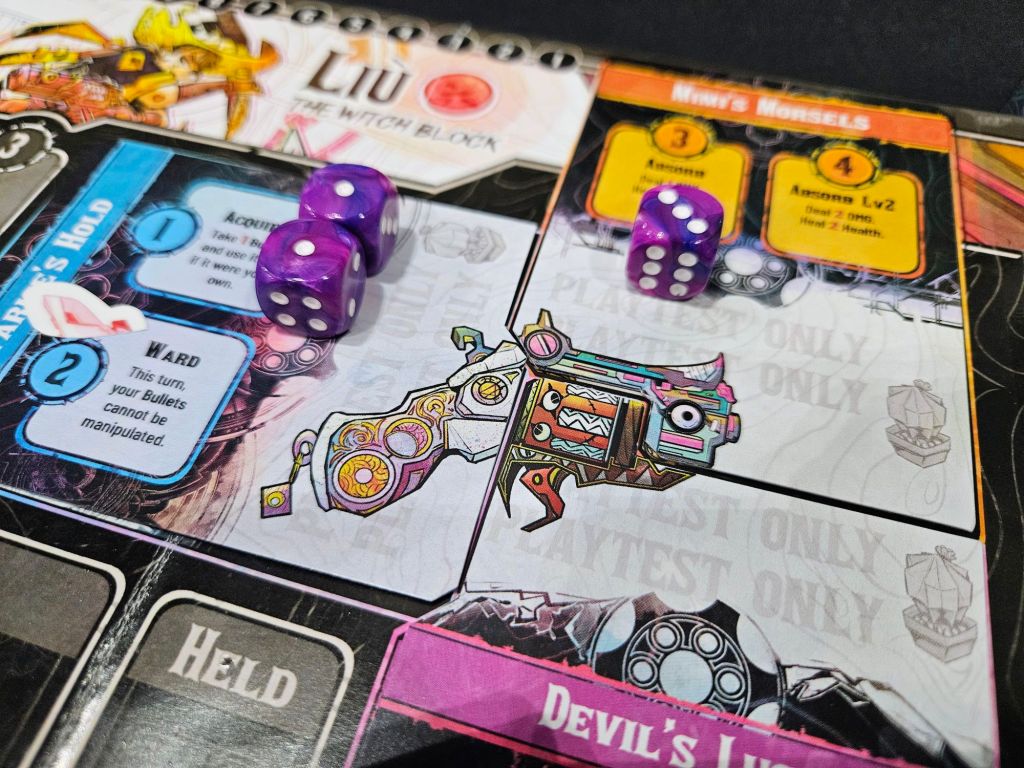
In a round of HexIron players draft gun parts cards, decide if they want to install any of them on their gun and then roll dice to see which abilities of their gun can be activated this turn. There are three parts to a gun (and thus three decks of cards) and you can pick which ones to add to your gun at the start of each turn. Cards can also be played for special once off abilities on their backs (which you also get if you replace a part on your gun). Once players are happy with their gun configuration, dice are rolled (which you can gain and lose) and assigned to their numbered abilities. After that players run through their abilities in numerical order. Abilities will allow you to deal damage to other players, gain dice, heal yourself and so on. Eventually someone will murder everyone else successfully and the game is won!
HexIron is VERY IMPRESSIVE for a prototype game. It’s clear a lot of time and effort has been put into the amazing art, graphic design and gameplay design of this. I am specifically very impressed/enamoured with the way that the 3 types of gun part cards have a unique shape that allows the gun art to fit together to make a unique gun for every card combination right there in the middle of your player mat. I’m keen to see where this game goes and if you are too you can keep an eye on Paper Cactus Games!
Indie Games
Apart from games in the Collaboratory I also got to have a look at a number of other indie games. These games are all available now for purchase but come from small independent publishers.
Delta Rummy
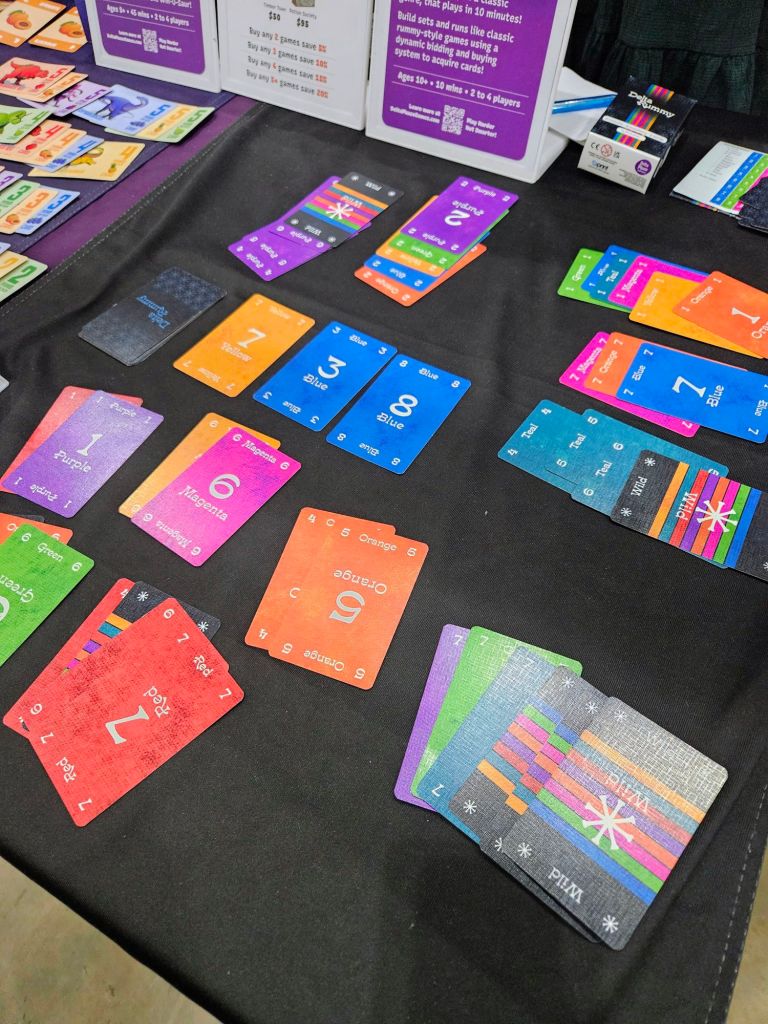
I swung by the Delta Phase Games booth and Eris was kind enough to teach me his “Express Rummy” game! After a one minute explanation we were playing.
Delta Rummy plays in rounds, players bid a card from their hand to win cards from the market and then play cards won and cards from your hand as sets or runs. Gameplay is quick and everything was over before I knew it! Eris told me this game was designed so he could play with his Mum, I really appreciate how accessible this game is, it’s definitely a “play with your parents” sort of game! Delta Rummy is available right now to buy from the Delta Phase Games store
Aqueducks
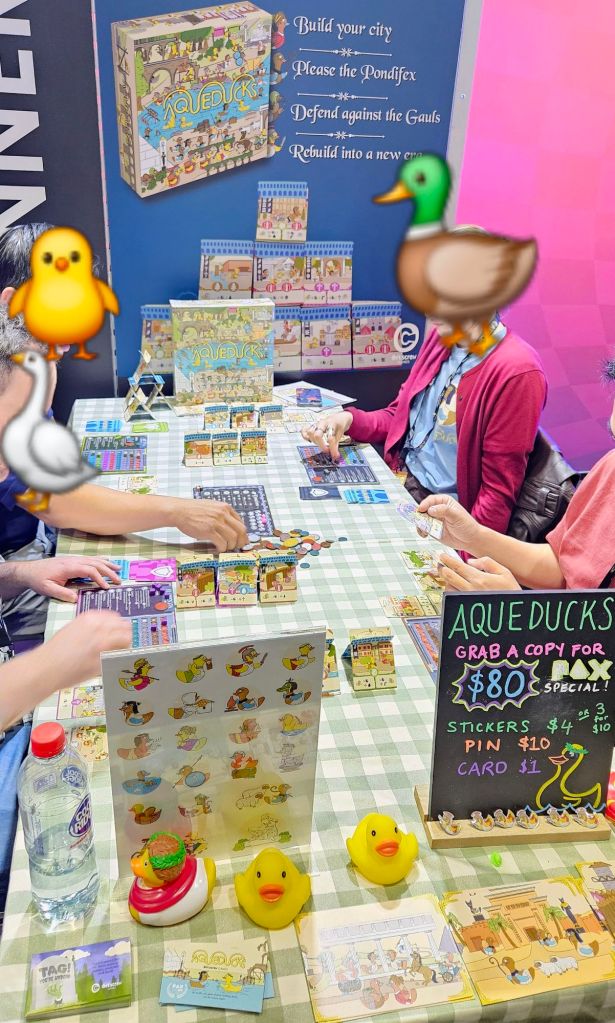
I didn’t get a chance to play Aqueducks (their booth was in the PAX game showcase area and was very busy!) but I love a good pun and had a nice chat with one of the designers of the game who was happy to indulge my curiosity on the processes, logistics and engineering involved in manufacturing a card with a slot in it. (I was very impressed and satisfied with the level of detail provided in the answer).
Aqueducks is a deck building game where you also literally build a structure from the unique slot-together cards that the game uses. It looks very cool and it’s exiting to see game innovation and great puns coming from Australian designers. Aqueducks is available now on the Corkscrew games website!
Gravitas
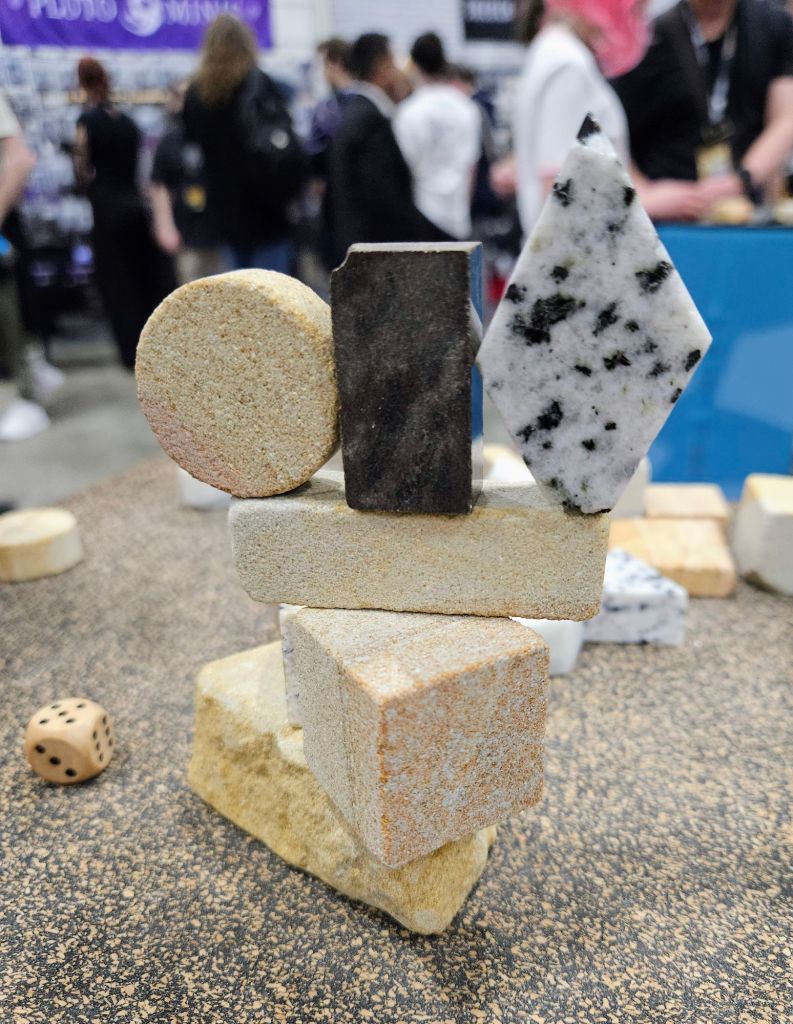
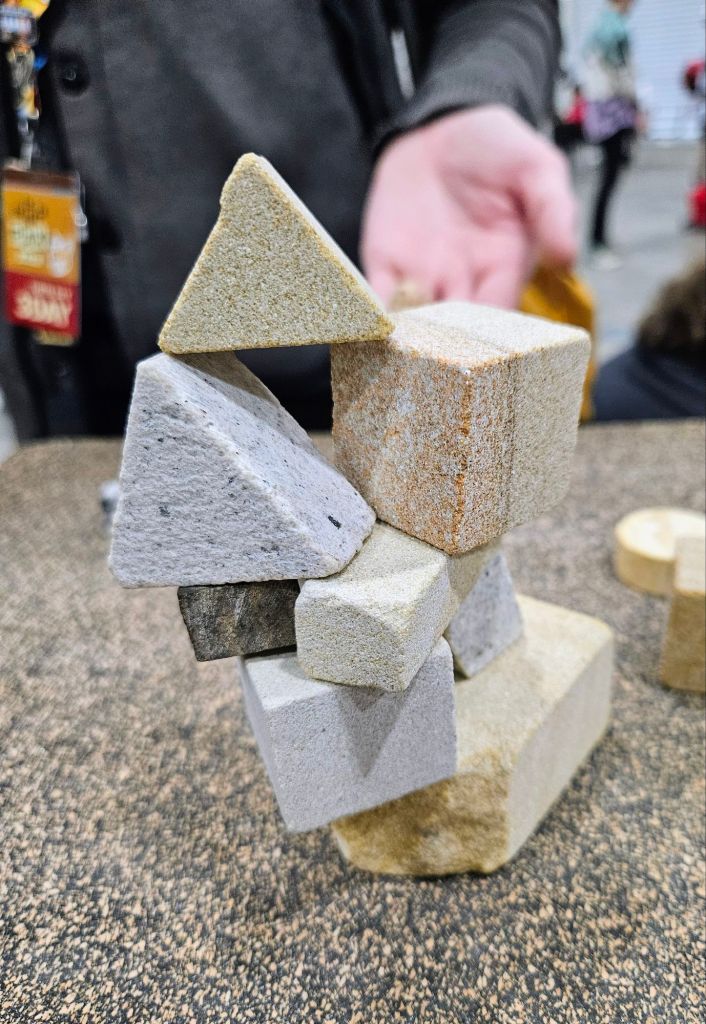
Rocks! Real rocks! Stacking! A cork/synthetic mat to stack on! What more could I ask for in a game. If you know me you know I’m great at stacking so of course I needed to have a go at this game. Unfortunately, for me the rules as written were quite a letdown – mechanics that punish unlucky dice rolls to the point you simply need to roll a specific number to win aren’t great, but ultimately it’s some cool rocks in a box and we came up with 5 different ways to make the rules more fun and strategic while we were playing. If you’re interested in getting a box of cool rocks you can find them at the Gravitas Game website!
~
I had a great time at PAX as usual, and I really enjoyed discovering all these new and upcoming games. I certainly look forward to following along the ones I liked to see where they go, and of course, wonder what of the many other great games there I missed out on! There’s never enough time to see everything. Thanks for reading!


