
| 👨👩👧👦 | Players: 1 |
| ⏳ | Time: 30-120 |
| 🎂 | Ages: 10+ |
| ⚙️ | Mechanisms: Dice rolling, map drawing, grid movements, endgame objectives, solo |
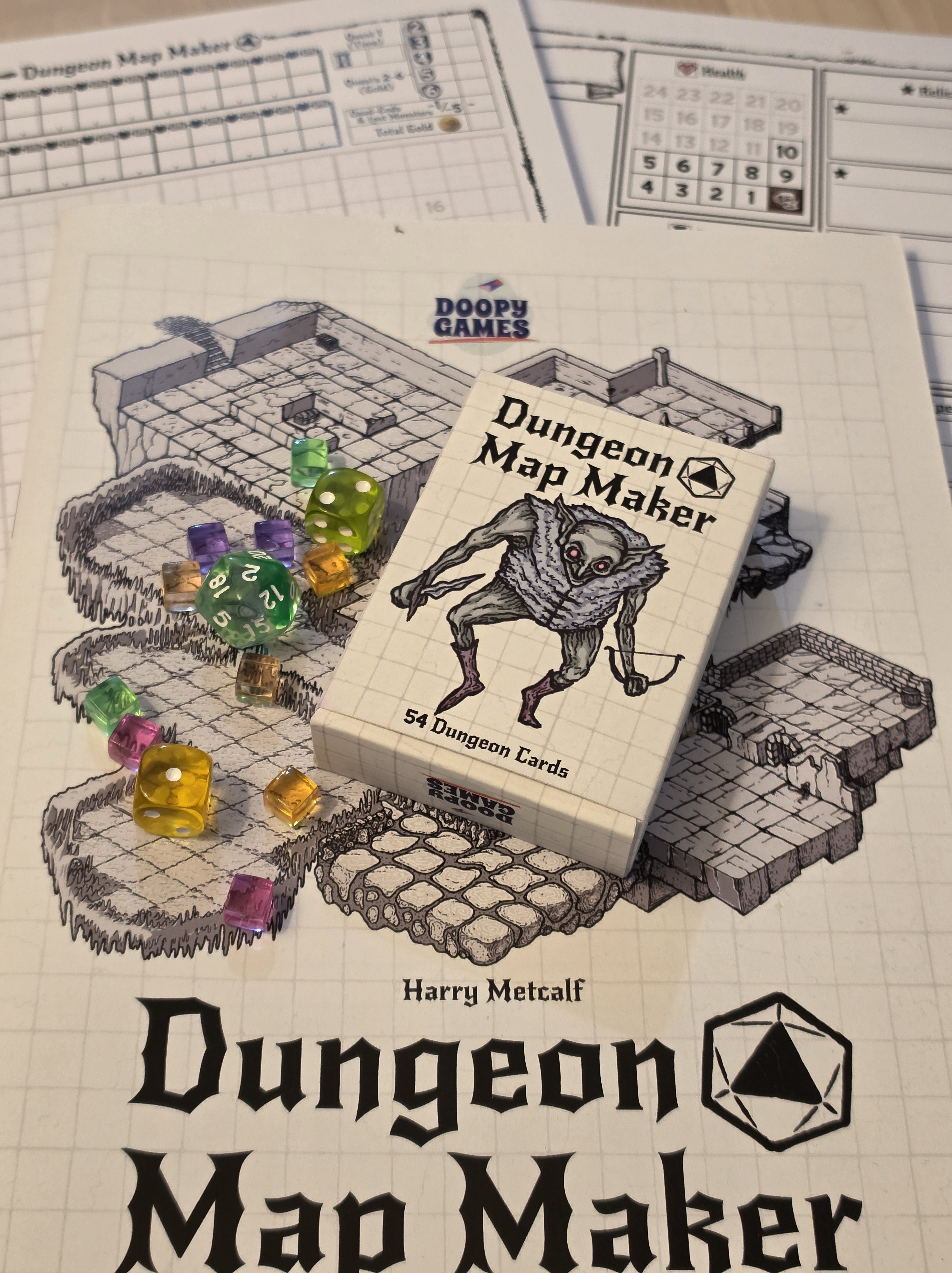
Dungeon Map Maker from Doopy Games (designer of Fantasy Map Maker) is two games in one. By day it is a dungeon-building spatial puzzle, at night it becomes a dungeon-crawling monster-fighting game.
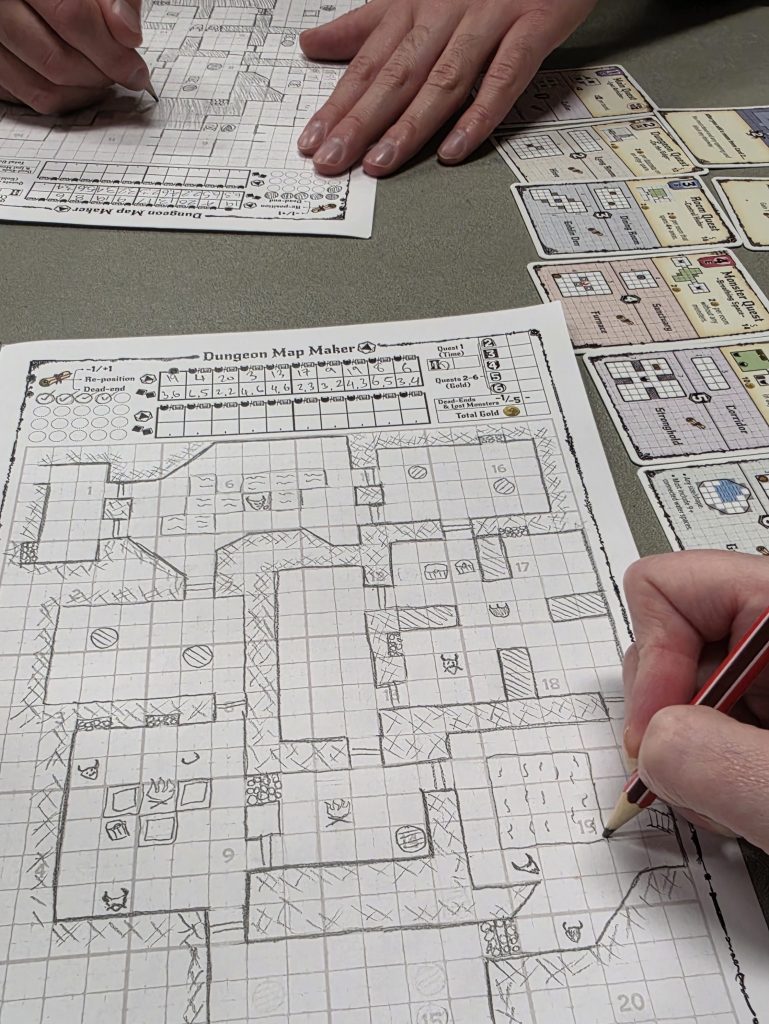
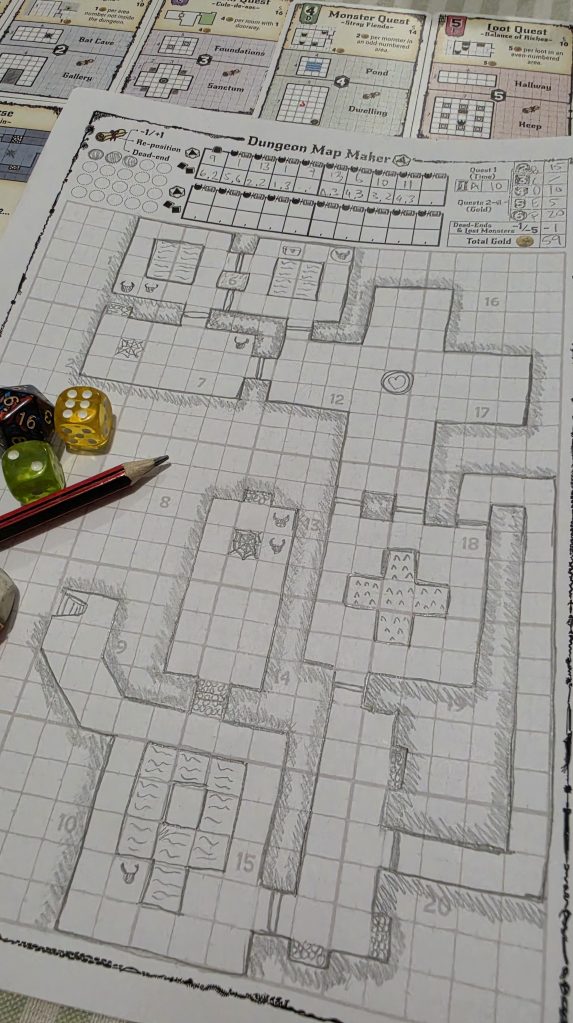
Yes, my art skills are average. No, I don’t know why those monsters have a moustache 😈.
You begin a game of Dungeon Map Maker using sectioned grid paper, dungeon cards, and dice. In addition to displaying room shapes and sizes, each dungeon card also has a scoring objective (one main quest and five side quests), which, when scored at the end of dungeon creation, determine your time and money for the second part of the game. In addition to the standard dungeon cards, you can also choose to add blessing and curse cards – which are triggered by the dice – to add a bit more complexity to the game.
Each turn, the dice are rolled to reveal which room you will draw (1d6, matching the number of cards), how many doors the room will have (1d6), and where you’ll draw either a monster or treasure (1d20, matching the number of grid sections). One thing I have discovered is that you really wanna make sure you have a good mix of monsters and loot in your dungeon – you’ll really need that loot to help you get through. The mapping phase ends when one of three conditions is met: a) you can no longer legally draw a room or an icon, b) you have completed all 20 rounds of mapping, or c) you choose to end the mapping phase before or after rolling the dice.
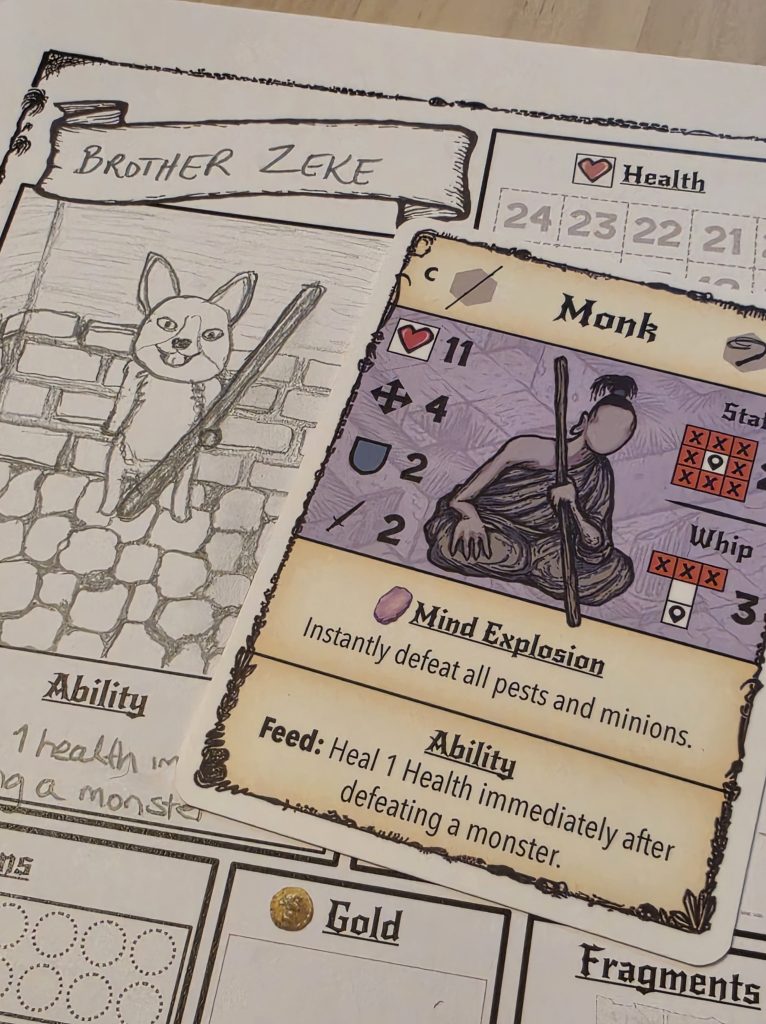
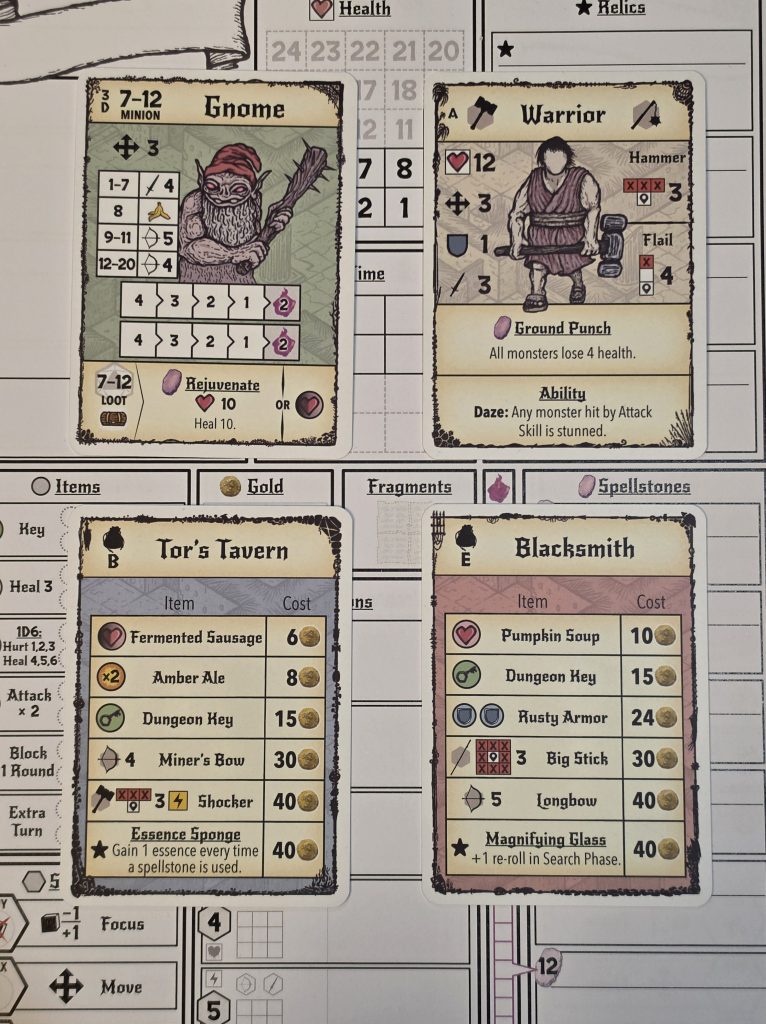
In no world would my corgi be a monk, but I can dream 😅.
The second part of Dungeon Map Maker starts with character creation. You’ll pick one of the character cards and transfer the information to your character sheet. Then you’ll use the money gained from dungeon quests to visit the shop (on the back of character cards) and buy them weapons, armour, and other useful items. Once your character is complete, you’re ready to explore the dungeon.
Now that you’re in the dungeon, there is a new quest to complete. The quest for this part of the game is found on the back of the main quest card. It is important to note that you will have limited time to complete your new quest. In the dungeon, time is measured by room visits. Each room visited consumes one of your available time slots, earned through your main quest when creating the dungeon. Just like in part one, the dungeon crawl ends in one of three ways: a) you complete your quest (you win, yay!), b) you run out of time to complete your quest (you lose, boo), or c) your character donates too many of their health points to the dungeon floor (you die, R.I.P.).
As you move through the dungeon, monsters will spawn in the spaces where you drew monsters. So, knowing that, you can plan for where they spawn from in early in the game. This will help you avoid getting ambushed by monsters as soon as you walk through the door (unless you like that kinda thing… I dunno, don’t let me tell you what to do). The monsters’ details are on the back of the dungeon cards used for dungeon creation.
Just like before, dice are used to reveal your options! The d20 determines monster spawning and actions, and the 2d6 provide you with your options for your adventurer’s actions. Each monster card has a range of actions they can take on their turn, as well as a health tracker. Your character sheet also has a section to track your health, in addition to places for your weapons, skills, items, and spells. Items that help you become a more formidable opponent can be found in rooms cleared of monsters, both in treasure chests you placed when designing your dungeon, and by doing a general search of the room.
Sometimes though, the monsters that spawn are too powerful; a swift exit is needed to preserve your character’s life. You can leave a room before a monster is defeated… but each monster you vanquish awards you “essence” for your spellstones (a special action you can take on your turn with specific dice rolls). And a room you run away from cannot be re-entered… so you lose your ability to search or loot that room.
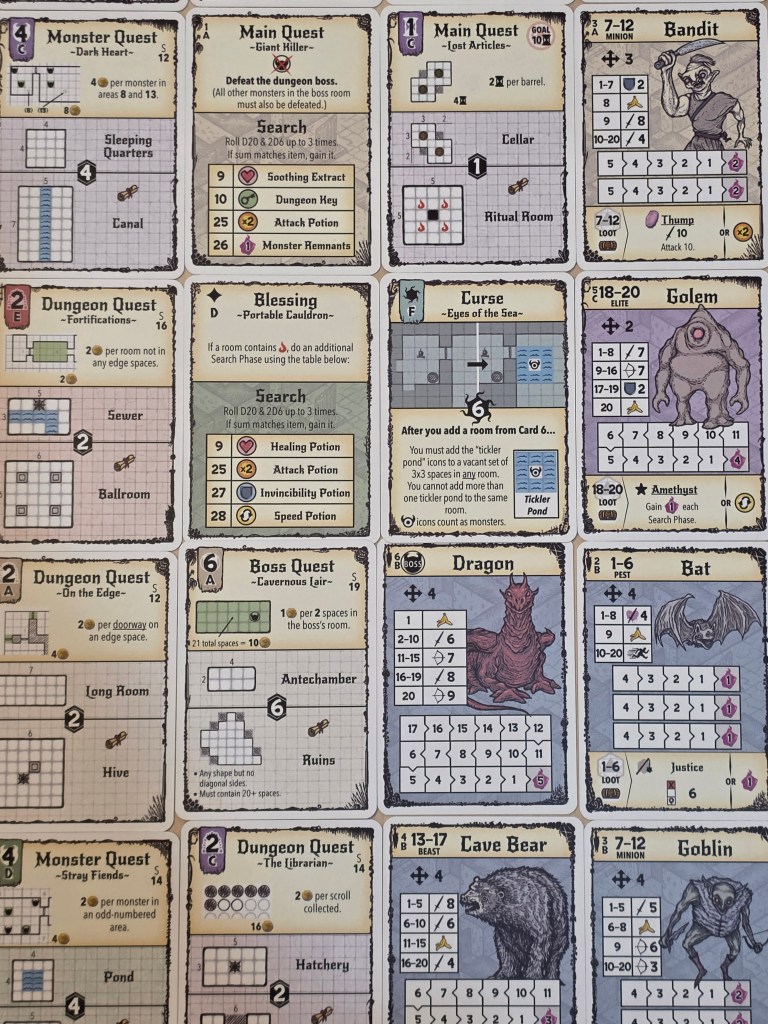
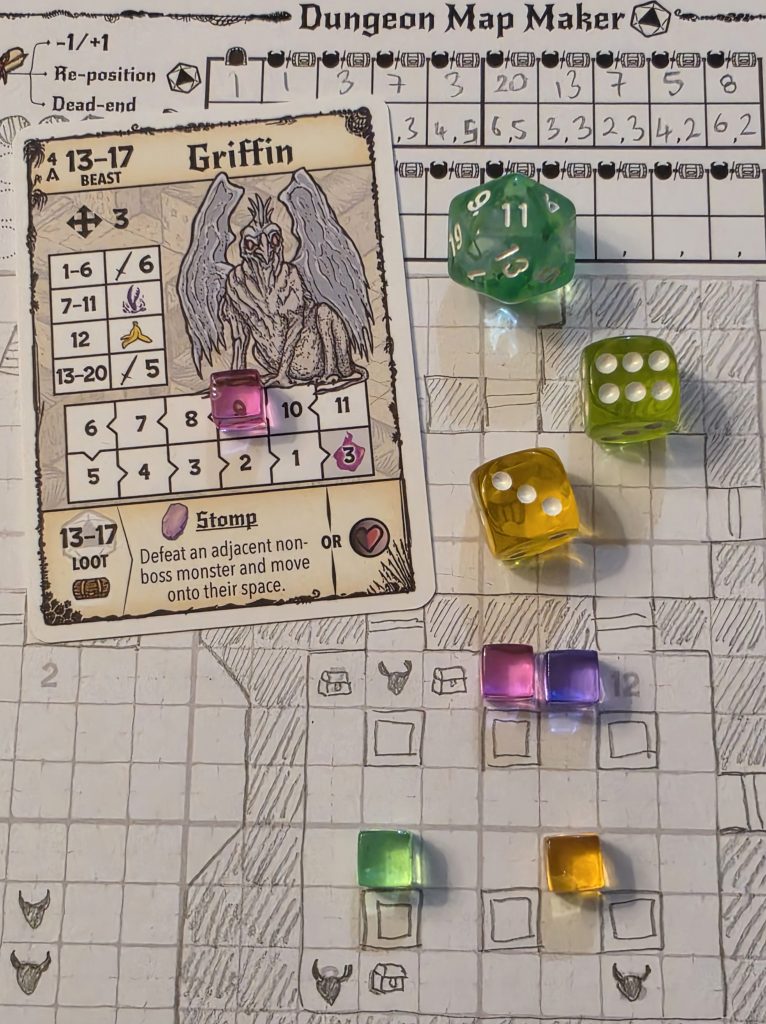
I can confirm that trying to run away from all the horrors is not a good dungeon (or mental health) plan… sometimes you just gotta face them.
If, like me, you love organisation puzzles, you will love the first part of Dungeon Map Maker. Lots of planning and consideration goes into deciding which dice to use for room selection versus making doorways. Deciding where to place your rooms on your grid can be tricky too. You want to leave yourself enough space for more rooms, but also place rooms in such a way that you can close all your doorways (or be stung with negative points). Oh, and make sure all the monsters are secure within the walls of a room (or lose more points!). Oh, oh, and you also need to choose the options that will help you fulfil the quests, so you have enough time and money for the dungeon crawl portion of the game (so you know, not too many factors to think about😉). As in life, I too often find myself focusing too much on side quests, and not enough on the main quest.
The final part of Dungeon Map Maker (exploring the dungeon) feels a little more complex than the creation of it. Now you’re managing not only your part of the game, but the monster side too. Thankfully, most of the information needed is on the player sheet and monster cards. I really enjoyed creating a character and choosing the weapons and items they’ll take with them into the dungeon. Unfortunately, in the dungeon, I had terrible luck with my dice rolls. I almost always spawned monsters that were absolute tanks (and more bad luck; my poor rolls meant the monsters also loved attacking me), while I was still a weakling. All that said, despite my poor luck, I still enjoyed the challenge of the dungeon – so look out, monsters, I’ll be back!
Next time I enter the dungeon, I am hopefully going to implement some ways to circumvent the issues I encountered. I’ll be more selective with the dungeon cards I choose in part one; I’ll be checking the synergy of the cards. I’ll be asking myself: How well do these cards work together? Will I be able to score highly on the objectives on these cards (so that I have more resources for my dungeon crawl)? What monsters (and objectives) lurk on the back? And I am undecided if this may be entering cheating territory… but I might even set my character up in advance, so I know how strong (or weak) my character will be. Next time I’ll (hopefully) go in equipped with improved dice rolls too!
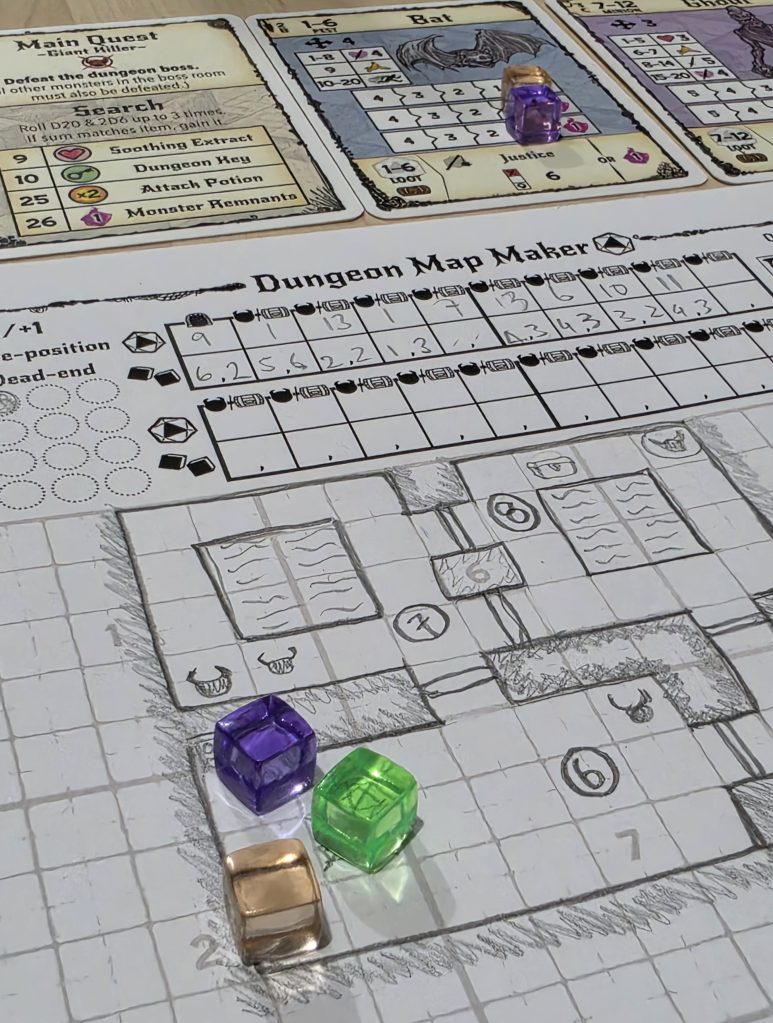
We can’t stop here, this is bat country😂.
One final note. Dungeon Map Maker is designed to be played solo. However, after chatting with the designer, I have also trialled the first part of the game (dungeon creation) as a multiplayer game. I have found that it works really well both solo, and with multiple people all using the same dice rolls. In my multiplayer session, it was fun to see everyone create such wildly different dungeons from the same dice rolls. The dungeon crawl is more difficult to adapt to multiplayer – each person would need their own dice, monster cards, and more cubes – and then it would just essentially be real multiplayer solo game… But I think it might be possible to send two adventurers into a single dungeon, taking turns to be the active player, so that’s what I’ll be trying out next. Perhaps with appropriate back-up, I won’t find myself quite so outmatched by the monsters lurking in the dungeon.
The copy of Dungeon Map Maker used for this review was provided to Board All The Time by Doopy Games.


