
| 👨👩👧👦 | Players: 2-4 |
| ⏳ | Time: 60-90 minutes |
| 🎂 | Ages: 14+ |
| ⚙️ | Mechanisms: Rondel, Tile Placement, Variable Player Powers, Automatic Resource Growth, Income, Contracts |
I didn’t think a game could become a favourite so quickly, but Crafting the Cosmos from Office Dog Games takes the beauty of space, adds the puzzle-y pattern placement planning (try saying that three times fast) of games like Calico, and combines it with the satisfying engine building of games like Everdell. It’s safe to say I’m hooked!
In Crafting the Cosmos, you’re building a galaxy. Each turn, you collect a variety of resources: nebulae tiles, stars, DNA and proto-life (which will hopefully eventually become advanced life forms), time crystals, gravitons, and energy cards.
To collect these resources, you use a very unique rondel system. You move energy around the rondel to accumulate resources. However, you acquire resources based on the state of all energy on the board, not just where you place your energy token. Each resource bay has active resources and passive resources. You receive active resources from the bay that your energy is in, but also passive resources from any bay that has energy in it. So, unlike some euros, you never really get that awful feeling of scarcity when it comes to resources.
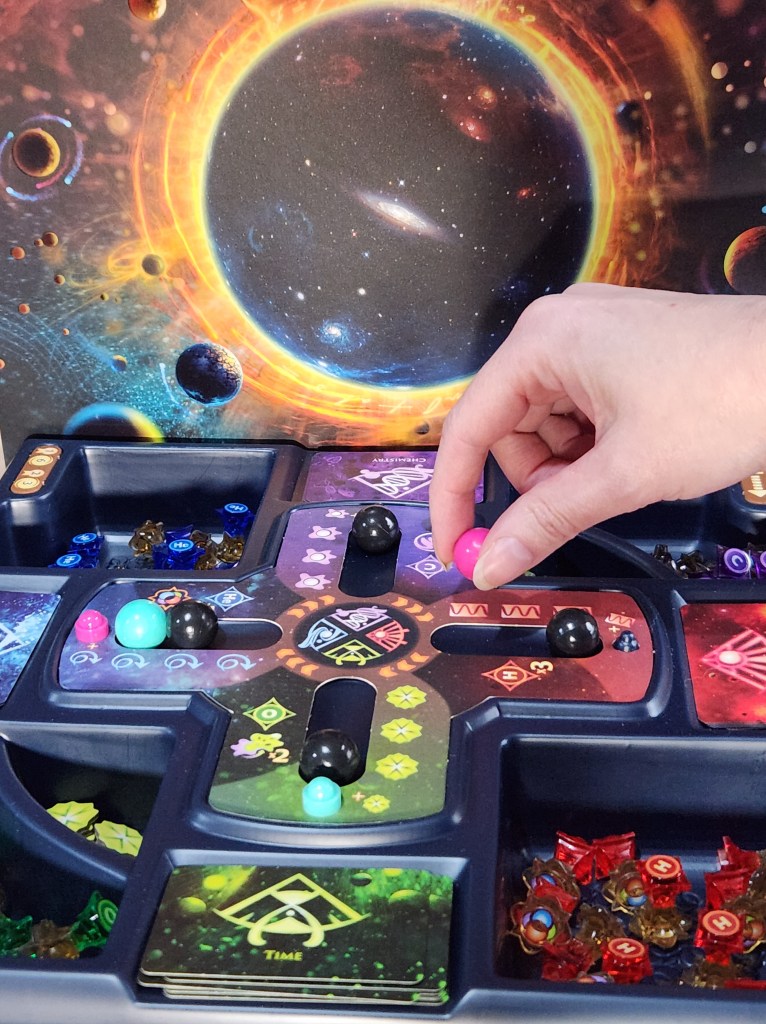
The rondel is clever, but the crafting phase is when 𝘺𝘰𝘶 start to feel clever.
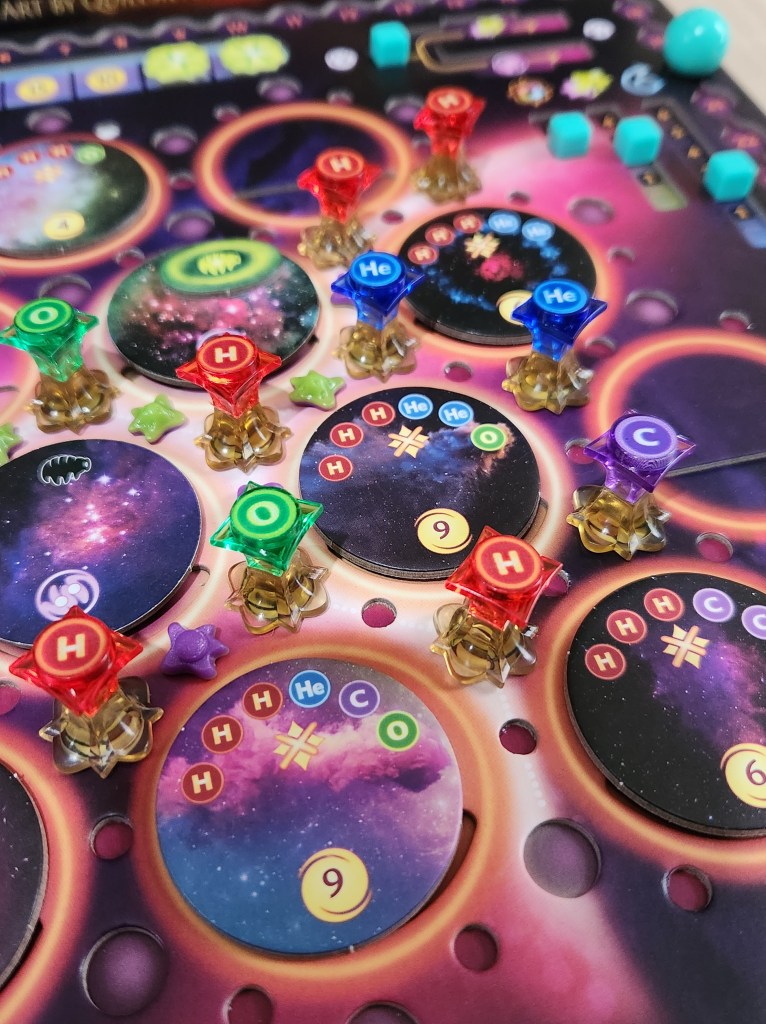
Now’s the time to use the resources you’ve gained, build the engine and watch it hum. Your nebulae need to share stars to optimise completion (scoring), but scoring a nebula destroys a star, so plan carefully! By collecting DNA/protolife to surround your completed nebulae with, you can create advanced life (and more points! yay!). With good timing and planning, you can use gravitons to move stars and DNA/protolife to chain completion of nebulae and advanced life.
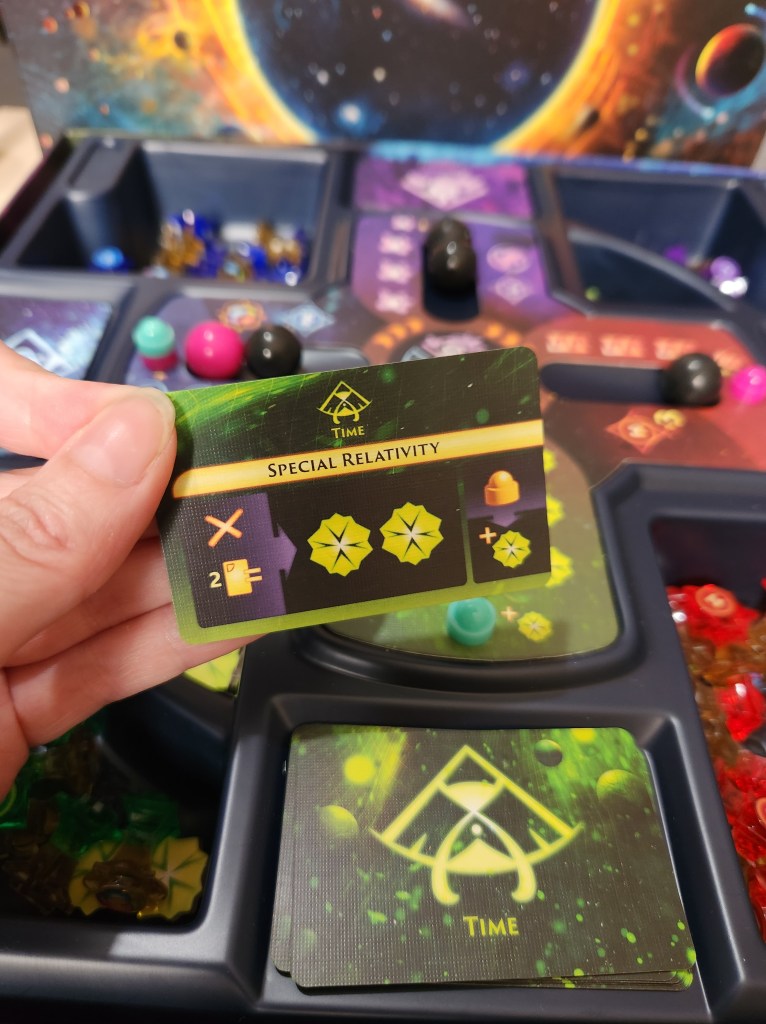
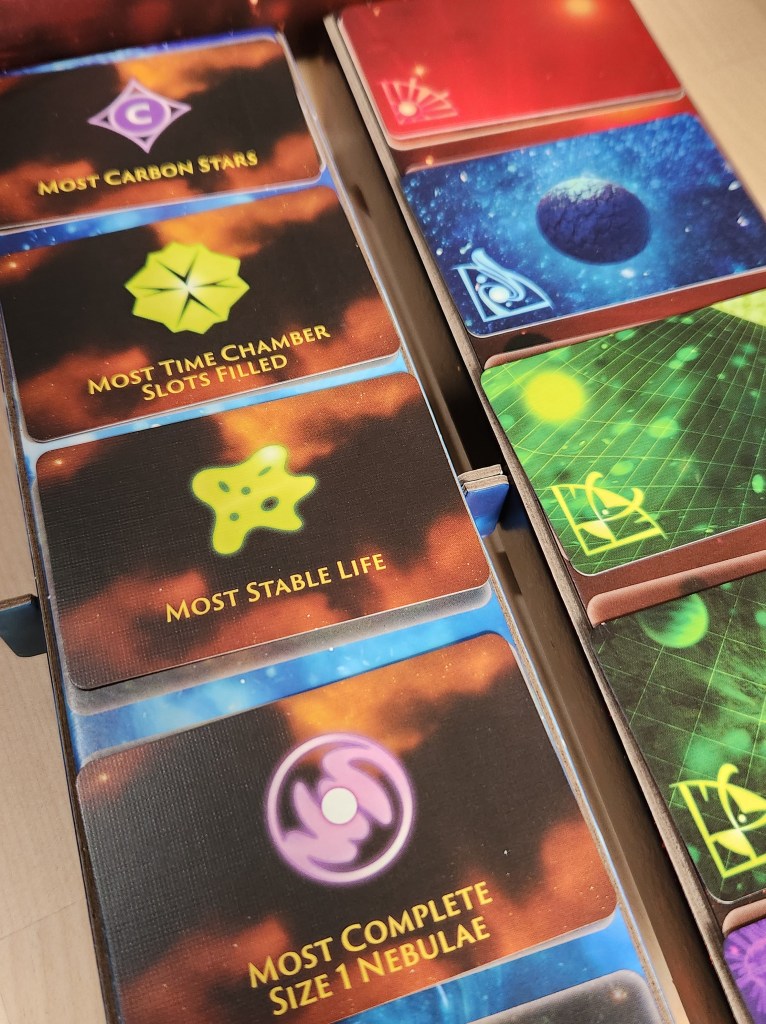
However, you need to be prepared before you make any moves. For DNA to continue creating more advanced life in other nebulae, it must first be stabilised into protolife, or it will be consumed in the creation of life. And nothing can move a star that has been turned into a wild supernova, so go supernova with caution! It’s also a good idea to accumulate time crystals. This is another good source of points, but they also provide additional stars to add to your nebulae. Energy cards will be another useful part of your engine. They can be turned into special powers that provide additional ways of receiving resources. Oh, and if you didn’t already have enough to do while building your engine, there’s also some universal goals that you should try to meet each round – for even more points, of course!
I have to admit that when I first saw Crafting the Cosmos, I was a little intimidated. Just from looking at it, I assumed that the game was going to be much heavier and more difficult to learn than it actually is. Thankfully, Crafting the Cosmos manages to offer the crunch of a meaty euro without being overly complex or mind-numbingly beige. It’s such a joy to see my galaxy come to life, with all its vibrant colours. I also love that there are so many ways to score points – each game I play, I try a new strategy for maximising my score.
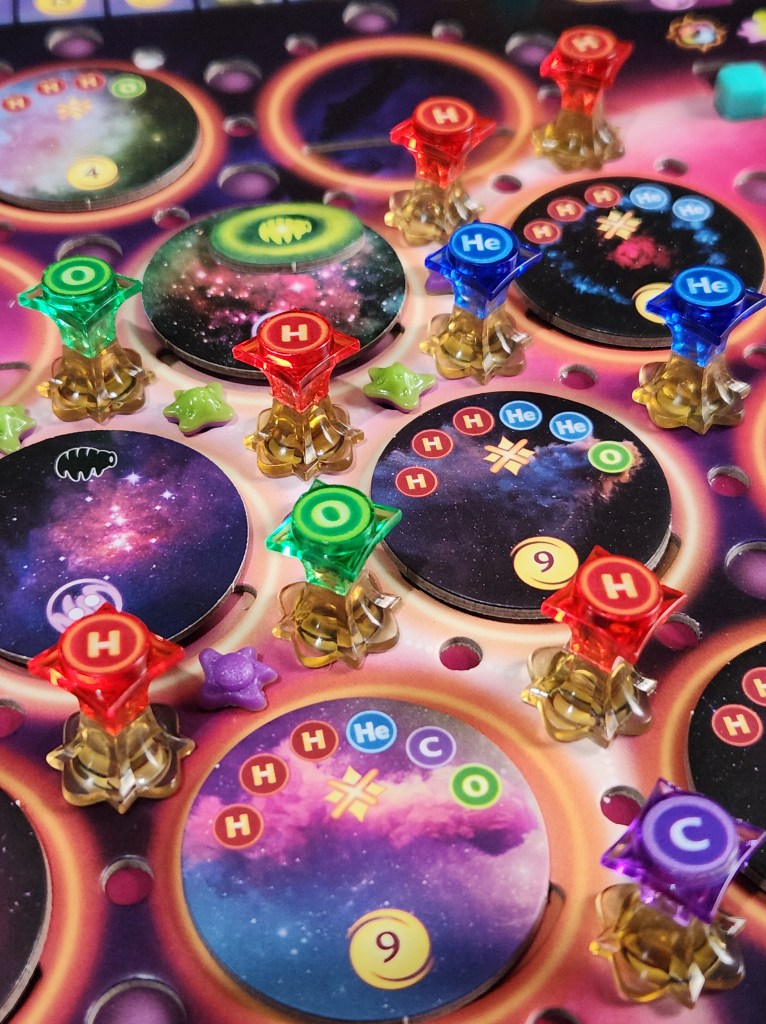
It wouldn’t be a well-rounded review if I didn’t point out a couple of small quirks of Crafting the Cosmos that some could find annoying. It can be a little fiddly sometimes to put/move pieces on the board, particularly the very small DNA/protolife, but I personally haven’t found that to detract from the gameplay. In terms of the gameplay itself, this is a game with very little player interaction, which I know might not be some people’s cup of tea. Personally, though, that’s exactly how I like my tea! My personal complaint? I can’t get it to the table enough!
You can see this post on Instagram here. For further information about Crafting the Cosmos, check out the publisher’s website.
The copy of Crafting the Cosmos used for this review was provided to Board All The Time by Asmodee ANZ.

 The Boardgame Detective