
As is usual, trouble is brewing in the woodlands. Oh wait…. wrong game. Uh, in space! Trouble is brewing in space. The woodspaceland creatures are all getting ready to prove who is the dominant furryscaly critter in this neck of the .. space. Hm, I’m struggling with this. Remember Root? What if it was in space? And kind of different? And the board was made up of Arcs? Welcome to Arcs.
2-4 Players | 2 Hours | Designed by Cole Wehrle
with art by Kyle Ferrin
If you want to have a quick look at all the stuff that comes in the Arcs box, check out our Arcs: What’s in the box? post!
Arcs is the latest entry in the four-letter-title-series from Leder Games. The game follows Vast, Root, Fort, and Oath and Ahoy in being illustrated by Kyle Ferrin, and was brought to life via Kickstarter. The game has evolved a lot from Kickstarter campaign to release, which is a bit of a hallmark of Cole Wehrle games, and the final release consists of a base game, a small ‘Lore and Leaders‘ expansion, and a big ‘Blighted Reach‘ expansion that brings to Arcs a campaign and ultimate storage solution. This review will cover the base game and Lore and Leaders stuff. I want to say here that Arcs is a ‘big’ game in terms of breadth and width of gameplay, strategy, emergent phenomenon and group meta. I’ve only played it 3 times at 3 players, so there’s probably a bit I’ve missed, but I’m keen to write up my experience so far and hope it provides a good illustration of the gameplay experience.

How does it work?
Arcs is a wargame (disguised as a boardgame) with an interesting ‘trick taker’ based action system. Players compete over a set of variable scoring conditions, aiming to have the most points in the last round of the game. Scoring conditions are ‘declared’ by players throughout each round, so players have some control over what will be scored – but the scoring condition you declare can be ‘won’ by anyone.
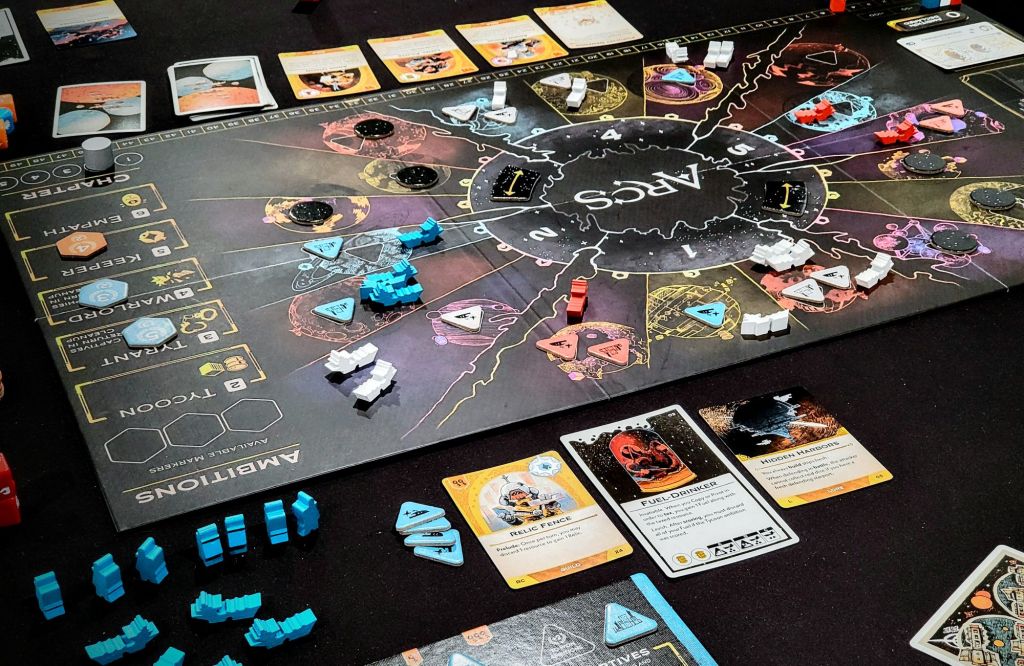
Chapters (rounds) in Arcs consist of playing through a hand of cards dealt at random to each player. There are 4 suits in the game (with values 1-7). Each suit allows players to perform a few different actions when that card is played. The player with initiative will play first, picking any card. They will carry out some number of actions and then other players will ‘follow’ them by playing a card. Depending on what they can play, they may be subject to performing a reduced number of actions.
Cards will give players actions such as Move, Battle, Build, Influence, Secure and Tax. Players will Move and Battle their ships to try and control sectors on the board and Build to get new ships and develop cities or starbases. They will Influence and Secure to gain powerful Guild and Vox cards which give new abilities and allow players to bend rules. Taxing will generate resources.
During each round, players will declare ambitions (objectives) such as ‘have the most of a certain resource’ or ‘blow up the most spaceships’. They will use the above actions to try and best satisfy the objective, thus scoring points for it at the end of each round. Arcs is a very dynamic game and big swings can happen turn to turn. In the chapter where a player passes the end game triggering amount of points, the game will end and whoever scored the most at that point is declared ruler of the galaxy!
What do I think?
My 3 game (so far) experience with Arcs has been a bit of a roller-coaster. After my first game, I was not feeling super great about the game but I put it down to it being the first play. After my second game, I was pretty upset with the game overall (how could Cole Wehrle do this to me again!!) but I was determined to give the game at least one more chance. I did some reading before my third game – I will discuss this a bit later – and I found I enjoyed it a fair bit more (as in, while it’s not exactly my type of game, I would now play it again). I have to say, I was a bit apprehensive to review another Cole Wehrle game after my not-so-great experiences with Oath and Pax Pamir more recently, but I like a challenge here and there, and things didn’t turn out too bad with Arcs. Let’s get into it! Oh, and I hope you don’t mind, I’m going to make a lot of comparisons to my experiences with Oath.
The Good Stuff
- Just like in Oath, Cole and Kyle have worked together to create a vibrant world, no – universe for Arcs to take place in. This world has a distinct personality and really brings the whole game to life. Whether by parody or homage, the clear parallels to the Dune universe are well done and help shape the atmosphere of the gameplay and lend a background to the emergent story of Arcs. I’m a big world-building nerd and this sort of stuff sucks me into any media.
- Overall, Arcs is a very robust production. It’s nothing fancy compared to Oath, but it is a very pleasant and cost-effective/financially accessible game (unlike Oath). For those who want a more premium game, there are optional upgrades available in the form of miniatures packs.
- I was quite impressed with the rulebook. Arcs is less complex than Oath (but I didn’t really know that going in) and I was very relieved that I could learn the game in a half hour from reading the rulebook. It’s laid out well to learn how to play from, and the player aids are mostly good (although there were a few small issues with them including a conflict with the rulebook).
- Arcs gameplay is straightforward, comprising of simple actions. The depth in Arcs comes from how the player chooses to compose those actions.
- Once we got going, we didn’t find a need to look much up in the rulebook as most things made intuitive sense or were easily referenced in the player aids.
- Playing Arcs, you really do get a good feeling of building up a great space empire, spending your fleets to crush your enemies, and sneaking around to try and snag a surprise win. It truly does give the same space empire feeling of bigger longer games (such as Eclipse) in a more succinct package.
- Just to bring this up again… Arcs is just much simpler than Oath. I’m a bit worried those who experienced Oath would be turned off by another game by the same designer+publisher but complexity-wise Arcs is just so much more accessible.
- The ambition system for scoring is very interesting. Up to three ambitions of the 5 available can be declared per round. There is a ‘first mover’ advantage in that early declaration means you are going to get more points for your desired ambition. But between declaring and scoring almost anything can happen, you aren’t guaranteed to get points for the ambition you declared, and of course declaring your intentions paints a big red bullseye on your head. It’s fascinating and in my opinion a much improved iteration of the sort of similar system that Oath used.
- Each action in the game has a clear purpose and it’s obvious what they do. The fun puzzle of the game is what order do I do things, how long do I wait for my opponent to be out of ways to retaliate, when do I declare my ambition such that I’m guaranteed to win it. There are a lot of interesting decisions, especially around timing and players very often surprise one another with out-of-the-left-field actions that throw all plans for a loop.
- Arcs has very satisfying combat (unlike Oath … sorry Oath). Because there are three ‘grades’ of attack dice and you get to freely choose what to use, you essentially decide what level of risk to yourself you want to take on and how confident you want to be that your opponent is wiped out. The option ranges from 0 risk to you but a low probability of victory, to possible complete destruction of your fleet for a near guaranteed victory.

The Bad Stuff
- At the beginning of each chapter/round, you are dealt a hand of completely random cards that determine what you can and can’t do for the round. I don’t like that your ability to execute any planned strategy is massively influenced by this randomly dealt hand. This can be restrictive in two ways. Firstly you might not have any cards that have the actions you would like to do on them, which severely restricts your access to those actions. Secondly you can be cut down from 3-4 actions a turn to 1 if you can’t follow suit. Yes, there are ways to ‘deal’ with this issue, but it sucks having to spend at least half your turns during a round burning cards and doing actions that don’t move you forward. It doesn’t feel fun. This issue leads into the following point:
- I don’t really like the idea that there is a ‘correct way’ to play a game, and that (in this case) it is non-obvious. As I mentioned earlier after my poor experience with the game the first two plays I did some reading online about the card-play strategy. It seems that in Arcs, you need to fight against the common sense of how the game is presented in the rulebook and do some counterintuitive things to enjoy the game. I did those things, and the game was certainly more enjoyable played that way. Unfortunately the very premise of ‘needing to know the secret to play properly’ is a big drawback for someone who considers themselves casual in terms of competitiveness. I don’t mind games that can have ‘meta-strategy’ but in this case .. the game isn’t fun if you aren’t aware of it?
- If there is a specific meta for ‘playing right’ and it makes the game better… Maybe it needs to be mentioned in the rulebook. Even better, why not reframe the rules to make it clearer: pose seizing the initiative as critical to doing what you want and getting lots of actions, and possibly even explain the action pips system as ‘you usually get one action, if you are lucky’ (it’s literally luck) – ‘you can get bonus actions’. Presenting it the way it has been presented subverts expectations and leads to a feeling of frustration when on most of your turns you do just one action.
- In general, I was kind of underwhelmed by the Guild and Vox Cards. To me, they seem mostly situational. You can be lucky, but to make them ‘work’ you need to spend some time creating suitable situations for them. And of course, if you put in the work another player can pretty easily steal them…
- While the rulebook was very solid, we found ourselves needing to clarify cards online often. This was similar to Oath, both games have lots of rule-bending cards, and just like Oath I feel like the cards could have done with a round revision with playtesters. It feels to me like it would be so easy to make ambiguous text much clearer with simple rewording. It’s nice to see that Leder Games has set up a card clarification/details database on their website now but unfortunately, it didn’t answer any of the questions we had, we did find most (albeit non-official) clarification on BGG.
- Unfortunately, like many similar games, when you see all the ambitions get locked in and you have no chance to catch up you basically have two options: crying, or kingmaking. I’m not really a fan of either…
- I found there was a bit of an ‘unfun’ flaw in the ambition scoring system. A few of the ambitions involve collecting enemy pieces over a round and most gathered wins that condition, with pieces then being returned. I like that, but I liked less the other scoring conditions that relied on gathering resources/cards, which don’t reset each round. Of course, you can steal these things but that’s slow and someone with like 8 cards + resources is pretty much locked in for that goal and is going to declare it first thing every round. It would be interesting if you had to spend resources to score a resource-based ambition.
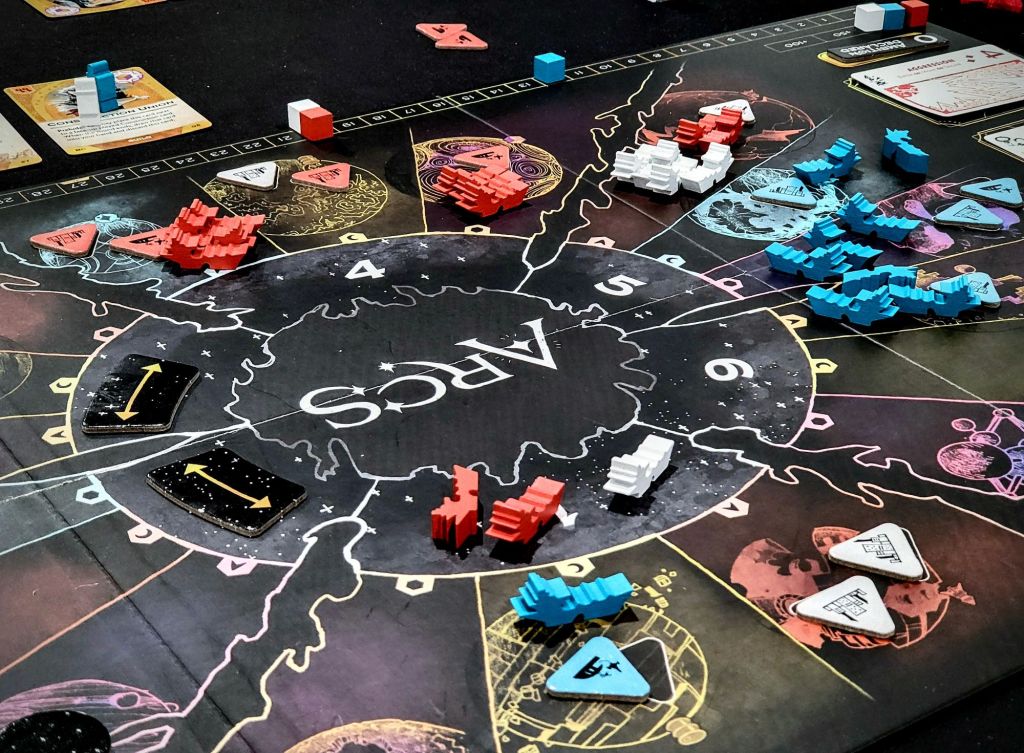
Arcs is super interesting to me. After playing a few Cole Wehrle designs recently, the design of Arcs feels like someone told Cole to chill – stop adding stuff to the game, dial back the kingmaking, get rid of the turn-to-turn wild board state changes. It’s still clearly his design but I would say it feels much more palatable to the mass market. Regarding my frustrations with the action card system – I accept it. I think I’m personally keen to explore more deeply WHY Cole made it this way. Like it can’t just be me who found this frustrating and with people saying this is the best-ever game there has to be something to it right? Maybe I just don’t find the ‘puzzle’ of adapting to my hand a fun strategic challenge. It’s just simply something I don’t like. The rest of the game though, it’s pretty good. I’m keen to play it some more and I think if you are after a more board-gamey wargame to play it offers a lot of interesting options and is easy to get into. If you want to find out more about the game or grab a copy for yourself, head over to the Leder Games Store. Thanks for reading!
The copy of Arcs used for this review was provided to The Boardgame Detective by Leder Games

 The Boardgame Detective
I played for the first time this weekend and I’m still thinking about what I would like to do next. My friend gave us characters from the ‘Lore’ expansion but I’m not sure if that was really the best way to start an already complex game. He did a great job teaching and next time, I will be far more aggressive! And maybe not pick a leader whose strategy is very “the game is now totally different for you” LOL
LikeLiked by 1 person
Hope your next play goes well!
LikeLike