
| 👨👩👧👦 | Players: 1-5 |
| ⏳ | Time: 60-90 mins |
| 🎂 | Ages: 14+ |
| ⚙️ | Mechanisms: Worker placement, asymmetric powers |
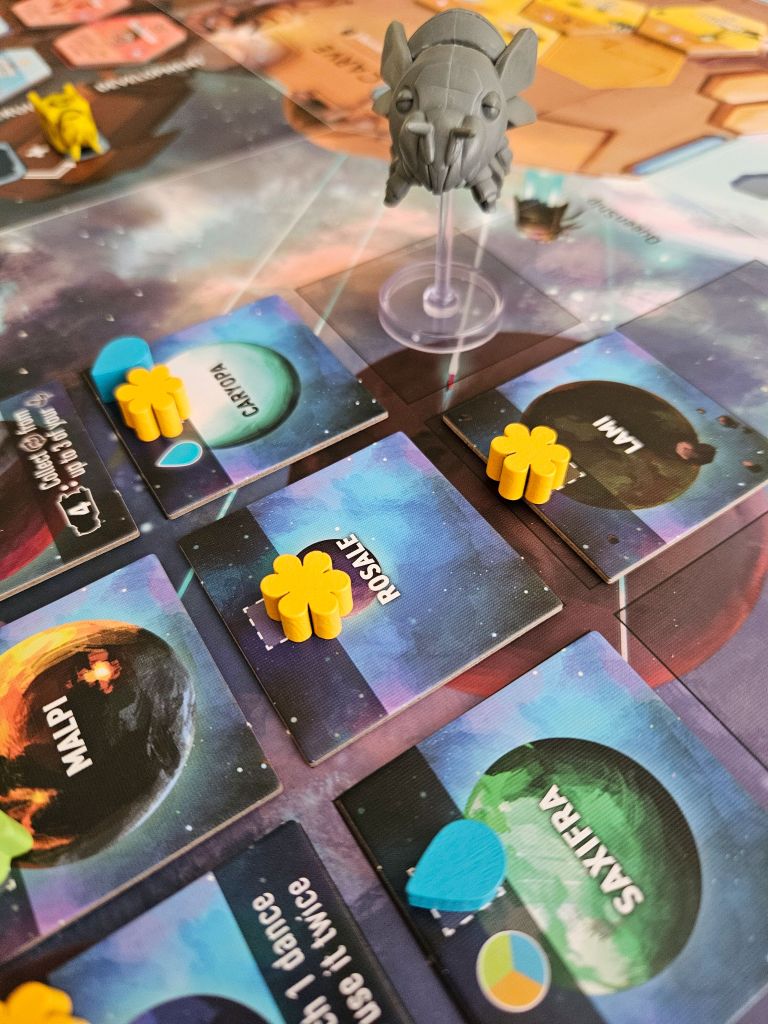
Centuries after humanity has fallen, the humble honeybee has evolved into a spacefaring race, trying to make their mark on the cosmos.
Exploring planets, gathering resources, and building up their hive, your space bees (🐝🚀) compete against the other factions to prove they are the bee’s knees.
What are we talking about? Apiary of course! It’s a worker placement game from 2023, and while we’re a bit bee-hind the times in trying it, we’re glad we finally have.
We really like how workers level up as you use them. Each time they come home they get stronger, giving you access to more powerful actions. There’s a catch though, they can only go so high before they need to retire, leaving you to recruit a new-bee to replace them.
The hive mats and factions are unique and can really shape your strategy, depending on the resources and abilities that you start with. This helps to keep the game fresh as you’ll be able to change things up each time you play. Occasionally it feels like someone gets too big an advantage from it, but that seems to be pretty rare and just adds to the challenge!
We honestly weren’t sure if we’d enjoy Apiary, as the theme includes two of Steph’s least favourite things – space and bees – but it turns out we both really like it! There’s smart gameplay, lots of different ways to score points (hello point salad my old friend!) and it gets better each time we play.
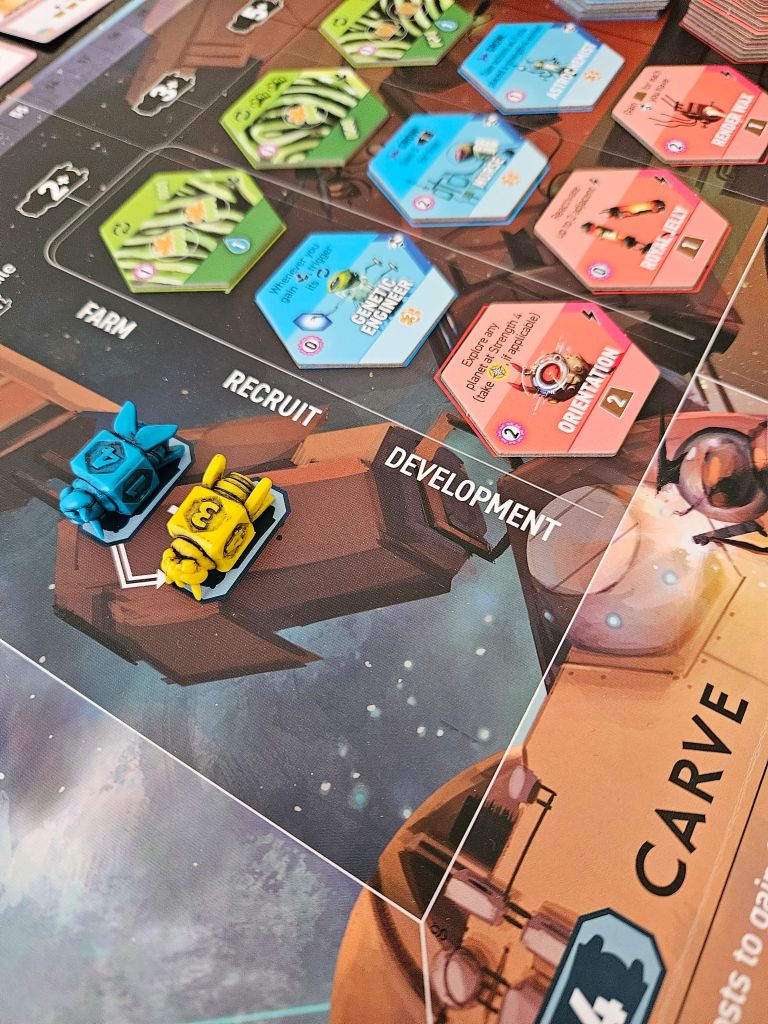
Sure, there a couple of rules that can be a bit tricky, especially around the levelling and hibernation stuff, but after a couple of plays it starts to click. Once it does you can start using those mechanisms strategically and it opens up a whole lot of clever options.
When we first played Apiary, the way your workers could knock other players off the board threw me a bit, but as time went on I started to understand just how clever the mechanism was.
Each section on the board has a limited number of spots for bees. It doesn’t matter if a bee is already there, you’re still allowed to use the action, but you need to be aware of the consequences.
What consequences? Well, your bee has to go somewhere, so it tends to get pushy and bump the bee that was already there out of the way, causing it to fly off home.
Whenever a bee gets bumped, the owner (and it could be you) gets to decide if it levels up ready for another go right away, or if it has a little rest until you’re ready to retrieve it.
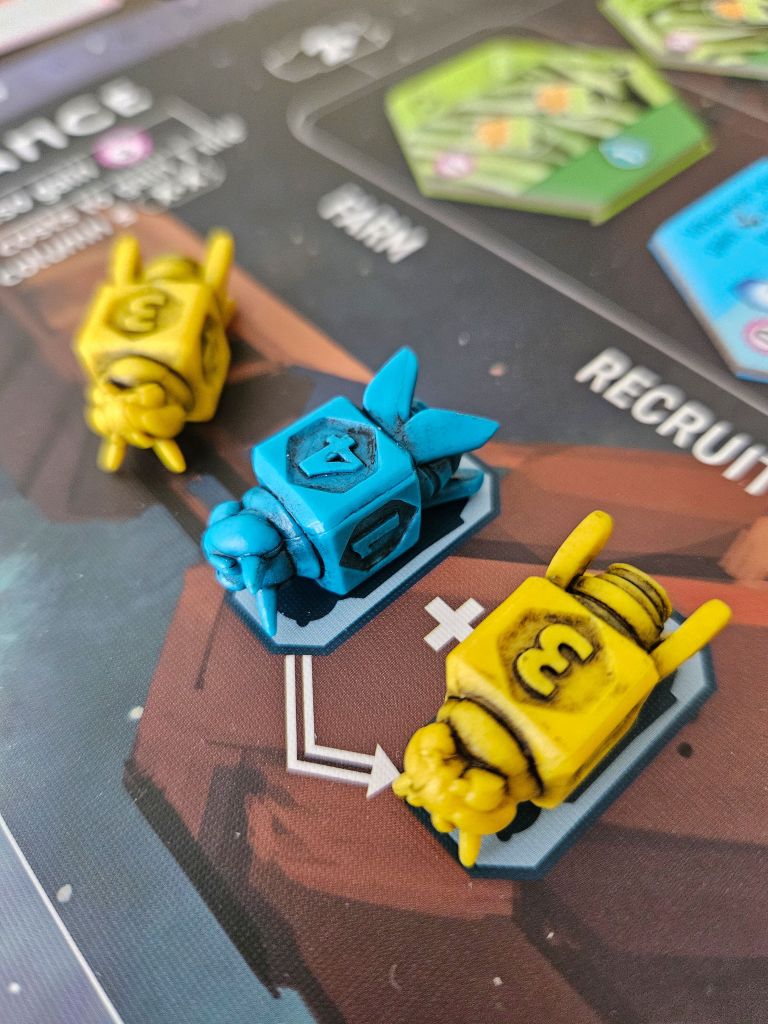
Why would you ever let it rest? It’s because whenever you take your bees back from the board, you can collect farm revenue from each one, including those you’ve put down in the rest area.
Don’t want it to rest? You’ve just given the owner a free power-up, making their next move stronger as well as bringing the game closer to the end.
There have been times when we’ve played certain strength bees ready to boost a future turn only to have our plans undone by the other player, and I’ve even seen Steph deliberately force my strength 4 bees to hibernate, ending the game before I was ready. Thanks Steph…
I love worker placement anyway, but the way it’s done in Apiary, while not totally unique, works so well with the rest of the game that it feels pretty special. That’s what I bee-lieve anyway!
You can see this post on Instagram here and if you are interested you can find out more about the game on the Stonemaier Games website!
The copy of Apiary used for this review was provided to A Tale of Two Meeples by Stonemaier Games.

 The Boardgame Detective