

Wow, what a great time I had at PAX Australia 2025! This years PAX had more tabletop stuff than ever before and I took the opportunity to experience some unreleased designs that people had brought to PAX to test and spruik. Of course, PAX is huge, and there were SO many games being play-tested in the ‘Collaboratory’. I also checked out some indie games over in PAX Rising – games that are out now or about to run Kickstarters soon!
The Collaboratory
Designers can book slots to show off their designs in the PAX Collaboatory, a sea of tables you can wonder and discover new ideas. Here’s what I found when I was there:
Crack and Stack
Crack and Stack drew me in with colourful cards, apparent maths and of course, dexterity challenges. The game is a puzzly party game that pits players against each other in battles of various intellectual challenges (word, maths, memory) interspersed with dexterity challenges. After a very quick explanation of the rules we started a game with the customary chant – STACK CRACK STACK SOLVE!!
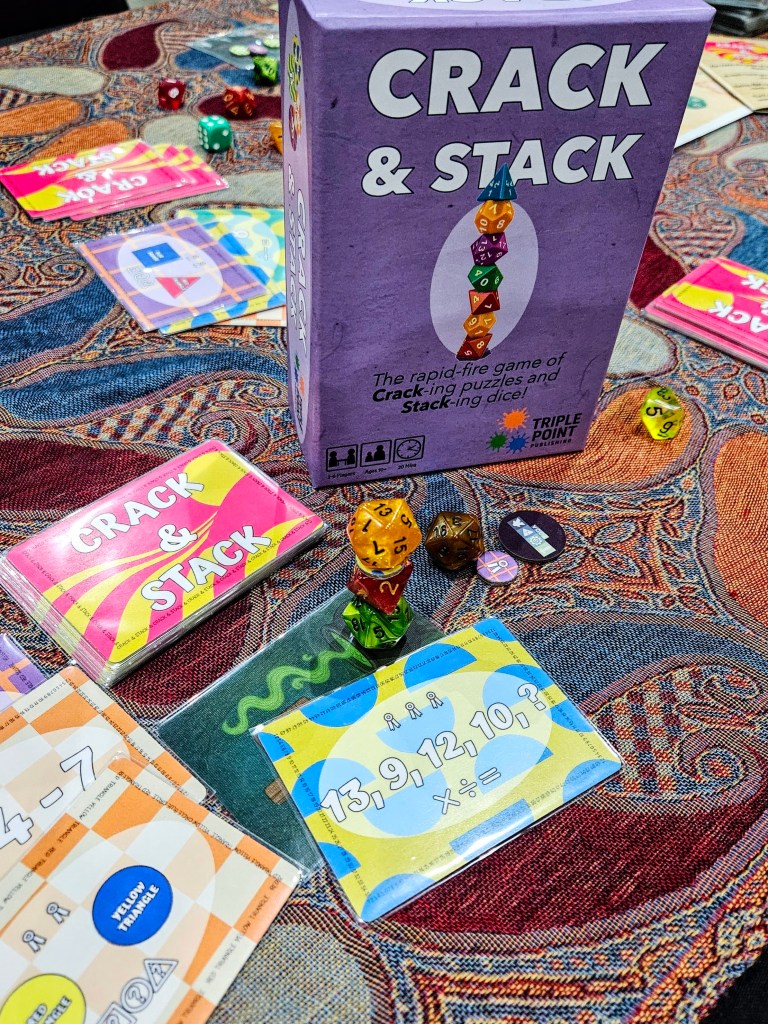
A round of Crack and Stack begins with players stacking their dice. You begin with 3 of various geometry. Once stacked you can draw a puzzle card and have a look. Puzzles come in the form of maths (e.g. solve a simple equation or finish a sequence), word (e.g. find an anagram or reverse a word), shape (e.g. remember the coloured shapes on a card). At this stage you are simply absorbing your puzzle, you could spend time solving it here or you can think about it further. After this you must flip your card face down, and stack all your dice on the card. First to finish gets best pick of the new dice (there are some you don’t want!). Then comes the tricky bit, each player must announce the solution to their puzzle card before turning it back over to see if they remembered it correctly and got the right answer!
I found Crack and Stack to be a really refreshing and exciting take on the party game genre. The interesting combination of both dexterity and puzzle solving seems to help smooth out skill differences and the game also features a few “auto balance” measures. I was really surprised how fun the game was and I would certainly recommend this game! Triple Point Publishing currently has it for sale on their website!
Aloft
I was drawn to Aloft by it’s amazing table presence! Aloft is a game about flying balloons at a very mean balloon festival. Designer Michael Purcell introduced us all to the game with a very polished spiel and teach. I am always very pleased by a game that tightly relates mechanics and theme, and Aloft links every mechanic back to the ballooning theme in a very satisfying way.
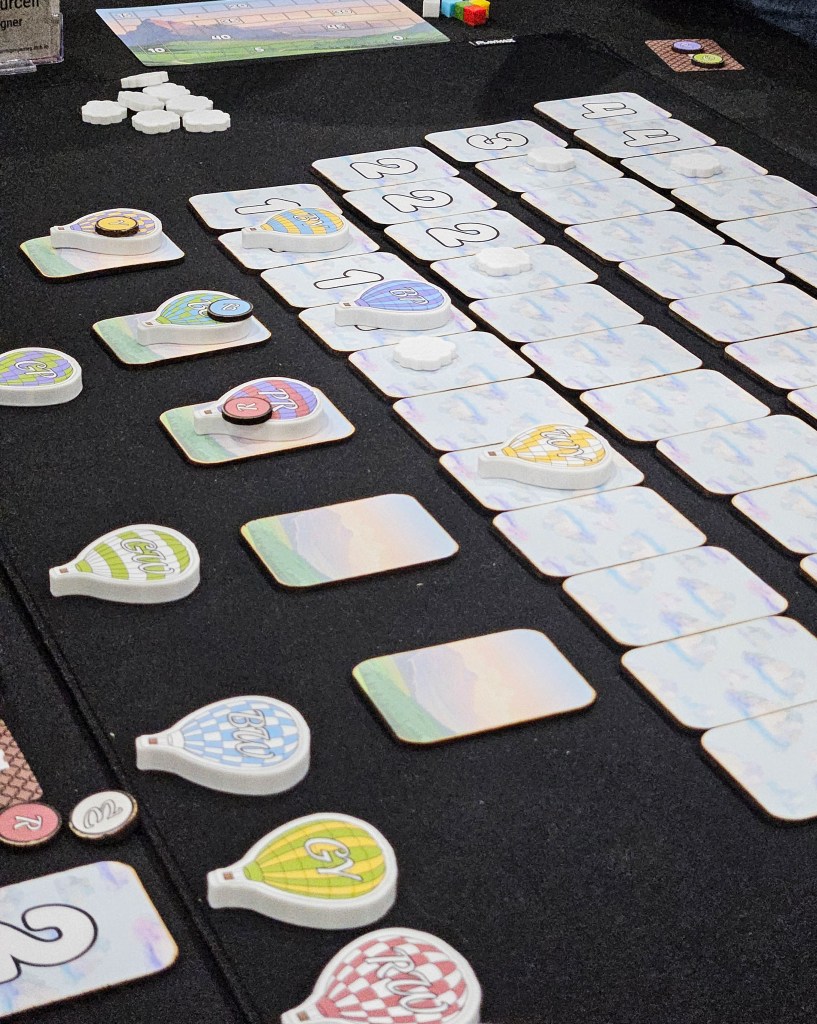
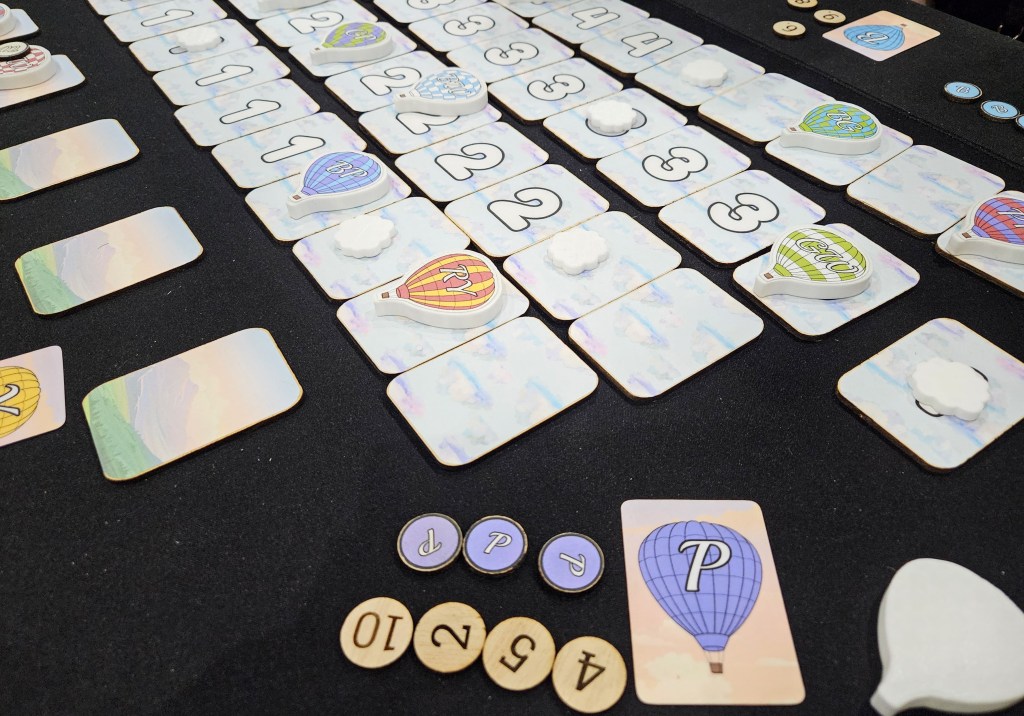
In Aloft players are competing to earn the most points at the end of the balloon festival by launching balloons and moving them up into the winds, hoping to have their balloons in the best spot at the end of the festival. Each player has a secret balloon colour and every balloon has two colours on it so players are all sharing their balloons with others. On your turn, you can choose to launch new balloons (which gets you some points) or try to move balloons upwards into the better scoring positions. At the end of each turn a nifty semi-random wind mechanic will move a row of balloons along. This can help get your balloons into a better spot, but it can also result in balloons being blown completely away, never to be seen (or scored) again! At the end of the game each balloon remaining will cash out points to the two players who ‘own’ it based on it’s relative position and most points winds!
I really enjoyed Aloft. It was clear to see that so much passion and refinement has gone into the design as it was very polished. I found all the mechanics to be really creative and very interesting. I can’t wait to see this game on my table and I’m sure it’s going to be a stunner when it’s done!
Remnant
Remnant: What if Cascadia and Harmonies had a kid and it was Australian? Remnant is a tile laying game themed around rehabilitating Australian bushland to bring some of the less “celebrity” critters of Australia back to their habitats. The game is created by Bugalugs Games, a father and son design duo.
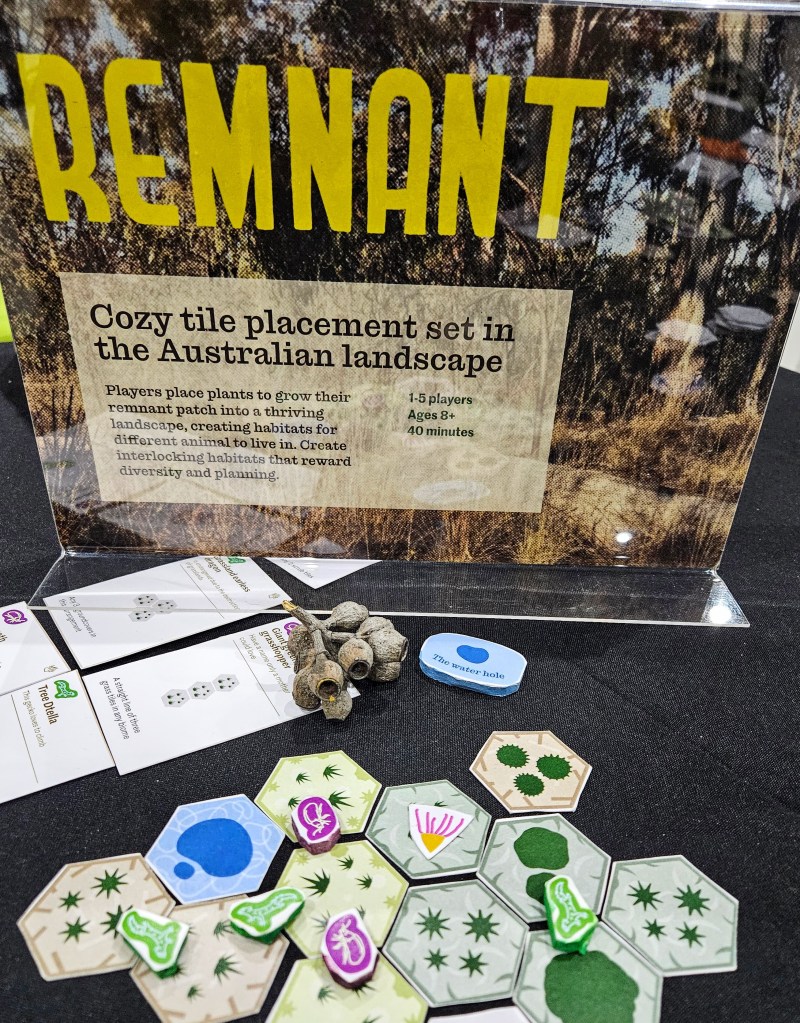
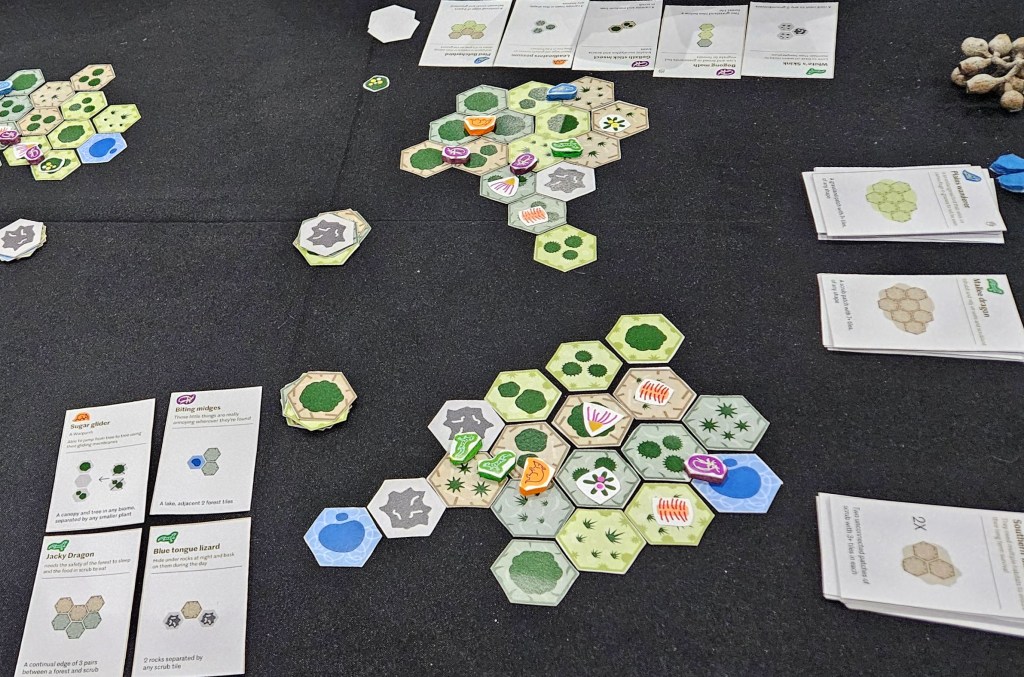
Game play of Remnant is pretty straight forward. On your turn, add a tile to your ecology in an attempt to create a suitable habitat for one of the 4 currently available critters in the critter display. If you do – you gain that critter card (points) and add a critter token to your board. Players are also working towards greater competitive goals and at the the end of the game whoever got the most points from critter cards and goals wins.
Despite doing REALLY bad at this game I found a number of elements of the game quite enjoyable. While it does nothing new, the combination of a few mechanics from other games makes for a nice and also mean experience. There is a lot of player competition in this game and you will spend a lot of time having other people take your goals just before you can get to them. I’m keen to see this released as “Cascadia: Australia” next year 😉. If you are interested in following along, Bugalugs Games has an Instagram account!
For Gods Sake
For Gods Sake is an upcoming title from Brisbane based small indie game publisher Delta Phase Games! I was lucky enough to get to play this with the designer Eris who was at PAX spruiking his published games at a booth shared with Isle of Feathers (a game I love that’s currently on Kickstarter!)
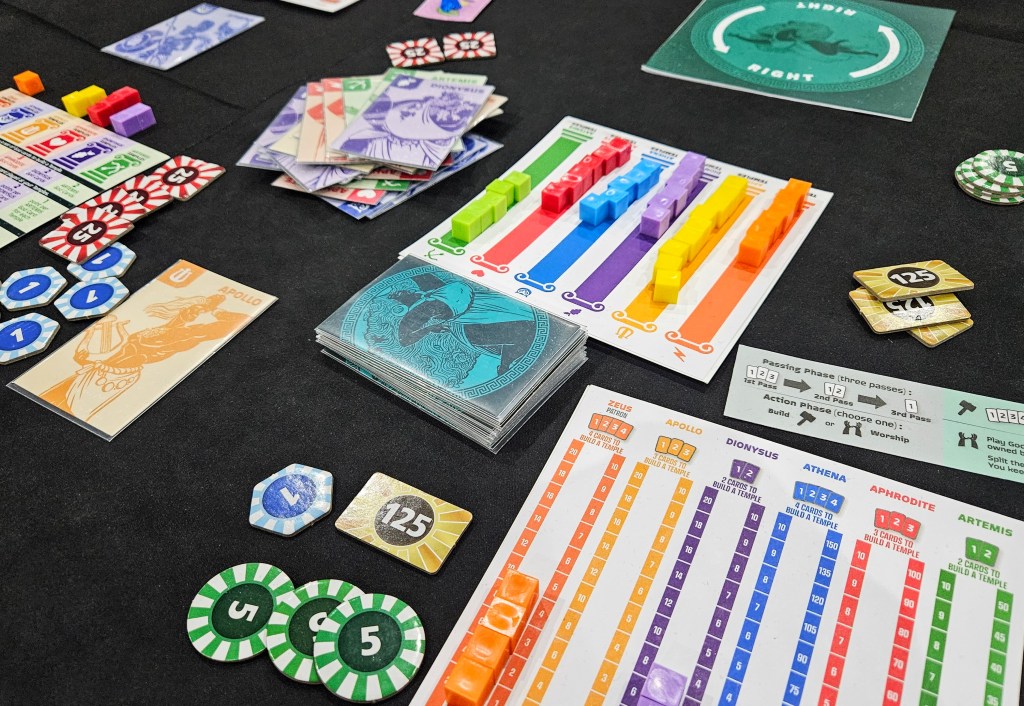
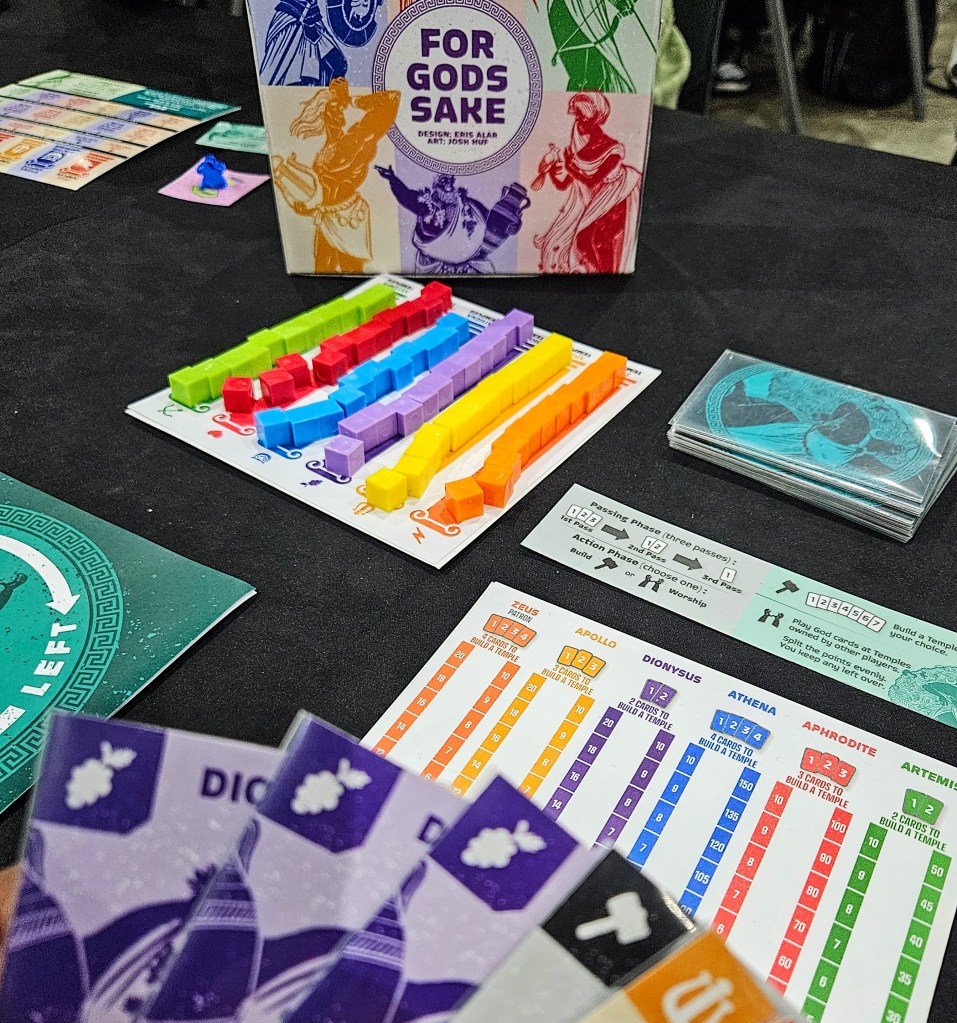
For Gods Sake could almost be called “7 Wonders Lite” based on the theme and card drafting mechanics, but there is a lot more to it. Players play across a variable number of rounds, drafting cards and then using those cards to either build temples or score points. You, (well someone), needs to build temples to score points – once temples are in play players can spend matching cards to generate points from them. The very fun and interesting part of this game is you can generate points using either your own temples, or otherwise using other players temples, sharing the points with that player. Often other players will have specialised in different temples to you so it can be attractive to use their temples but you need to be careful who you are handing points to.
I really enjoyed this game and I can see it being a great game for all sorts of crowds. The game is simple and accessible but brings with it a fascinating myriad of strategic possibility, and I’m pretty interested to see how some of my friends play this game! You can check out Delta Phase Games‘ website to see their already published games and subscribe to their newsletter if you are interested in the release of For Gods Sake!
Lose the Plot
Bugalugs Games has a bunch of ideas! I met up again with the team to play Lose the Plot – a game that can be described a bit like if Point Salad had a spatial element! I’m a sucker for a farming game and this one had a couple of unique mechanics that kept it fresh and interesting!
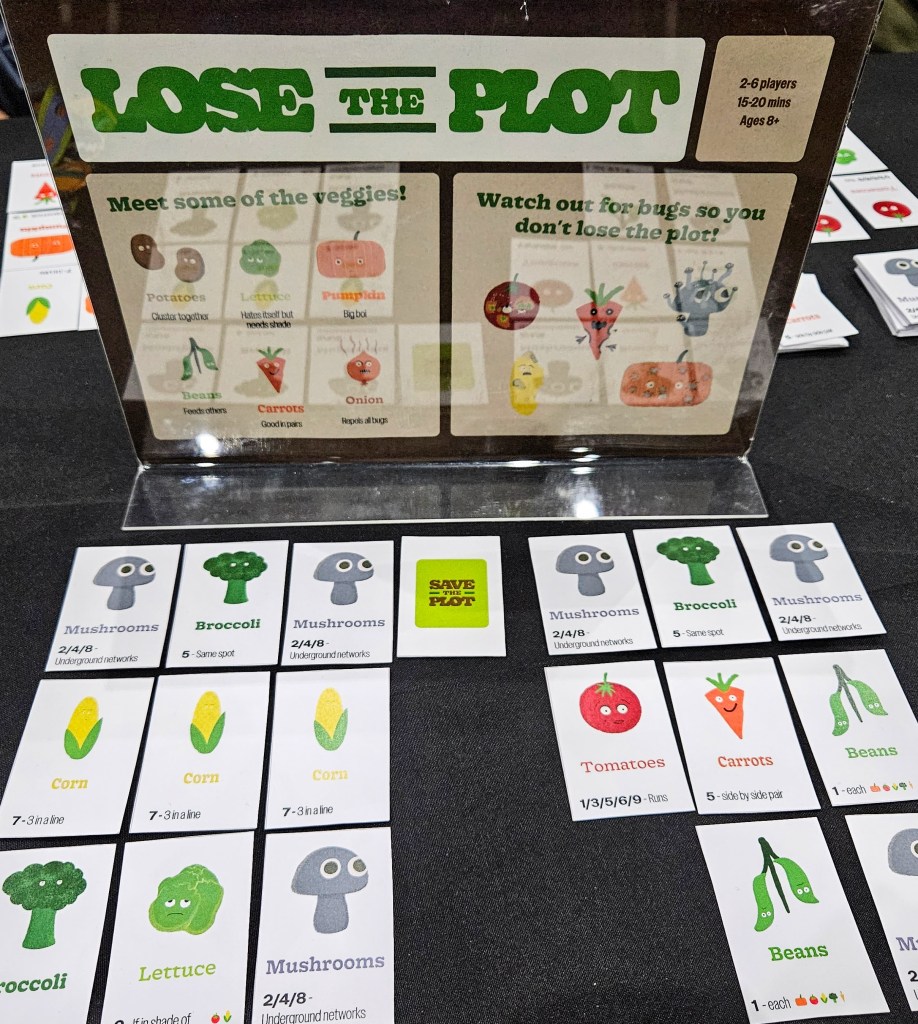
In each turn of Lose the Plot you will take a card from the top of one of 3 piles. Cards (veggies) are then placed into one of your two plots, neighbouring other placed cards and contained within a 3×3 area. Different veggies score in different ways, with some interesting mechanics comboing off the idea that you have 2 plots to plant in. The game features surprise bugs that will pop up in the deck and eat player’s hard won veggies, adding a fun(?) twist to the game.
I especially liked this game because I did very well. It was a bit rough (as the designer admits) it’s in the early stages but I think there is a very solid family card game to be found here. If you are interested in following along Bugalugs Games has an Instagram account!
Mobamon
Do you like Mobas? Do you like Pokemon? Do you like Boardgames? Do you also like things that are legally distinct for licensing reasons? Mobamon might be the game for you! Mobamon is a new game in development from designer Sean of Tress Games. Sean has previously published Cytress to much success, so this is certainly one to watch.
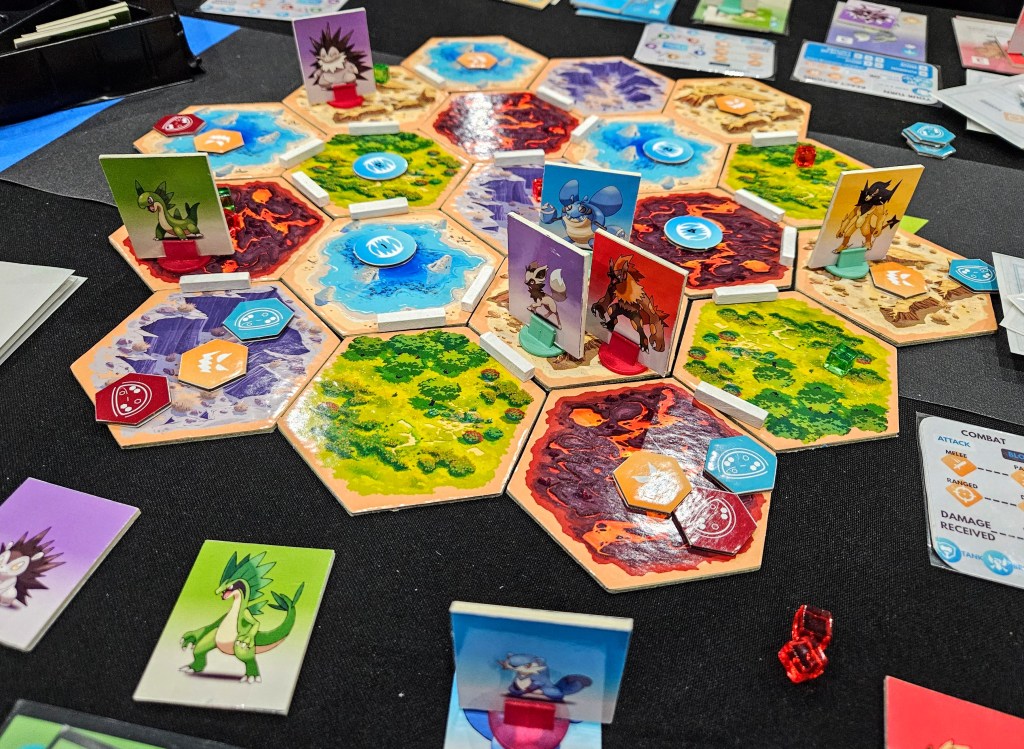
Mobamon is a combat and hand management game where players are racing to be the first to 10 points. There are two main ways to get points in the game, evolving your Mobamon (which involves moving to increasingly hostile locations and collecting certain cards) or K.Oing opponent Mobamon in battles. Players can focus on one or the other strategy, or more likely a mixture of both in order to hit 10 points first for the win. The game features a few innovative and interesting mechanics that are reminiscent of Pokemon combat.
Mobamon is already quite polished feeling even in the prototype stage. I didn’t play through a full game but the 10 or so turns I played felt pretty good. This isn’t exactly my kind of game but I thought it was pretty well implemented and seems like something of a next step for fans of something like “King of Tokyo“. You can see what Sean is up to on the Tress Games instagram page
Island Village
When I saw this game in passing the “Lego” factor immediately grabbed my attention and drew me in. Island Village is essentially Upwords but with terrain, and I think the photo of the game speaks for itself.
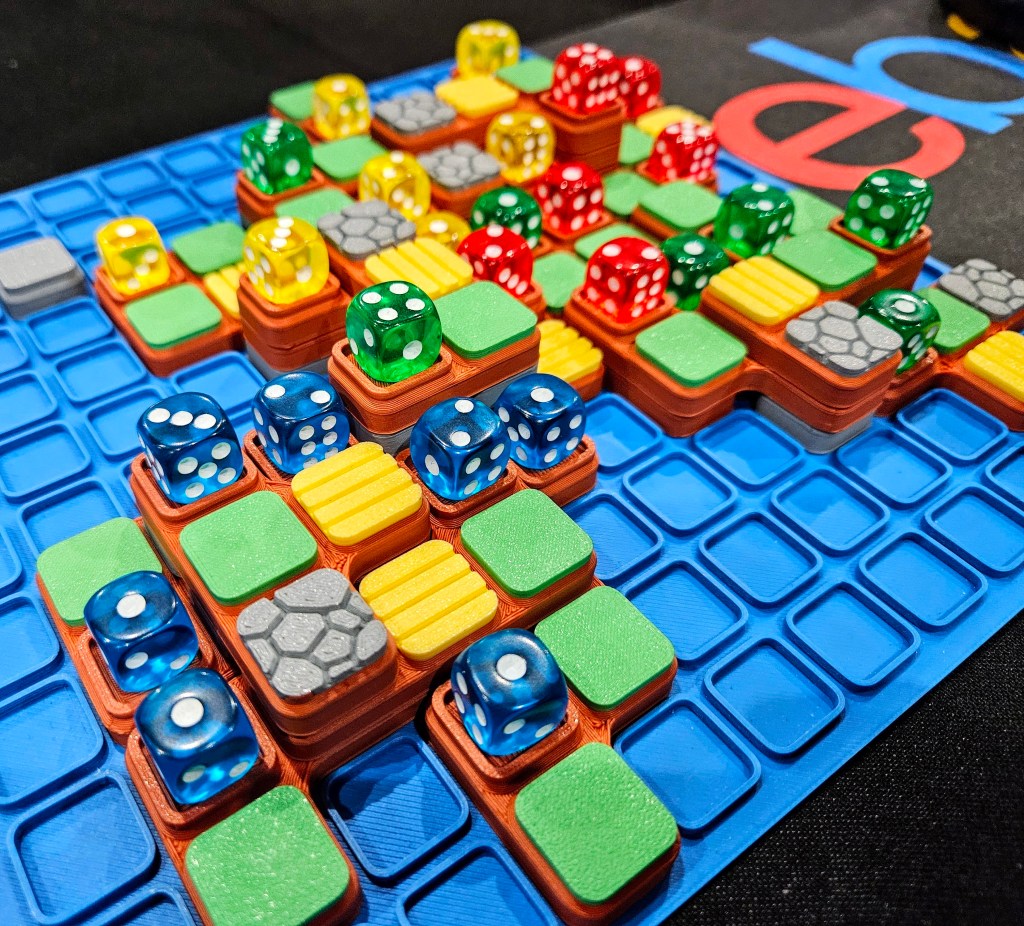
In Island Village players take turns adding tiles to the shared island. Tiles can be placed next to existing tiles, or otherwise added on top so long as they are fully supported underneath. Players have a small supply of stones they can use to support tiles. As each tile is placed, the player adds one of their houses (dice) to the tile, and once each player has placed 7-10 houses the game is over. Players score based on the height of their houses an get extra points for fields neighbouring their houses.
Island Village was easily my stand-out game of PAX 2025. The game is very simple but has a great depth of strategy, and is mean which I love. As soon as we finished playing I made sure to tell everyone I saw to publish this game immediately! I can’t wait to see this game published!
Indie Games
Apart from games in the Collaboratory I also got to have a look at a number of other indie games. I didn’t play any of these games but I thought they looked very cool and will be keeping an eye on them!
Cultured Swines
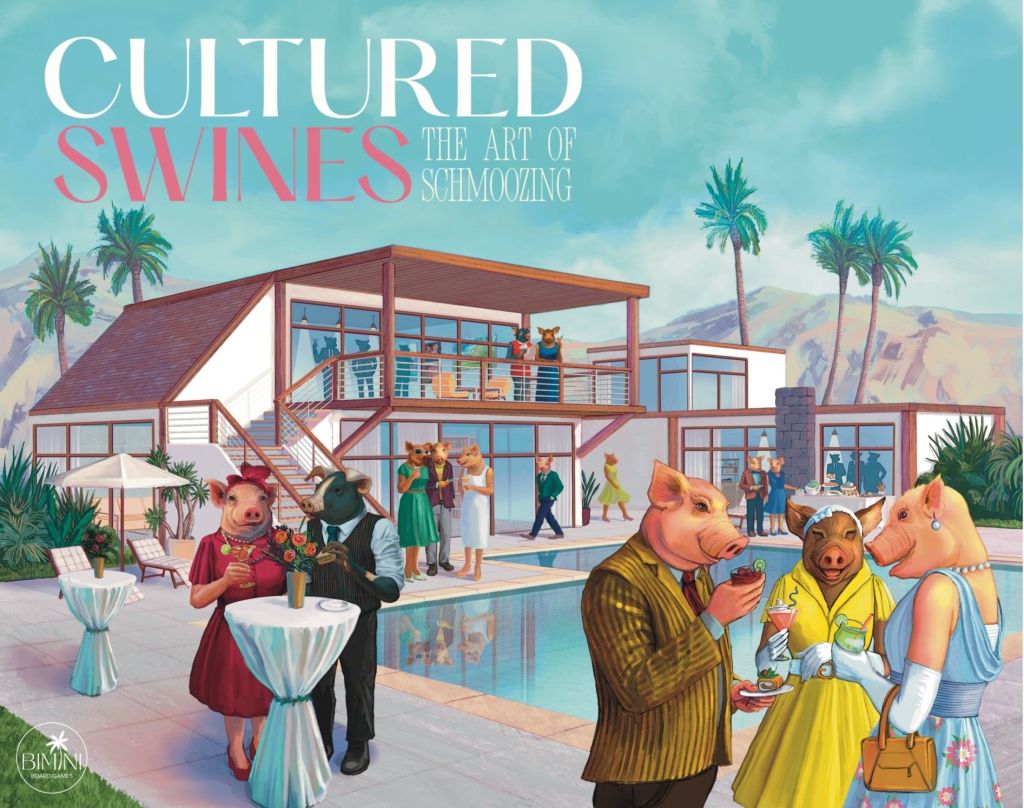
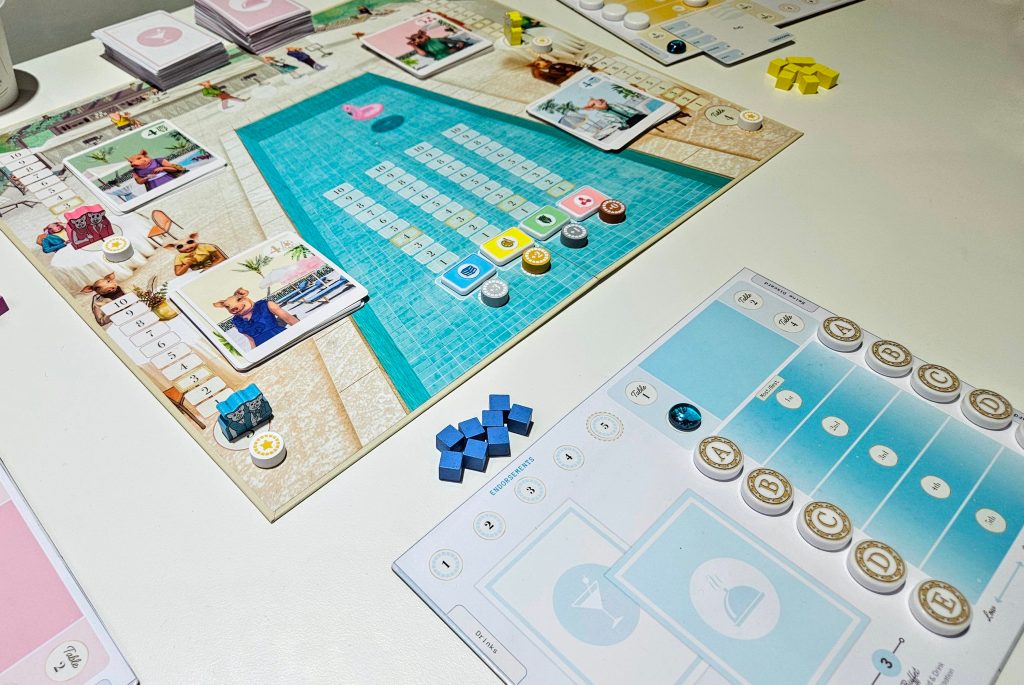
Cultured Swines is an upcoming Kickstarter that I got to take a quick look at. Players play in teams of two and are seeking to give off the best impression of themselves to the other swine at a party. The core of the game revolved around a “mind sync” mechanic where players are trying to order words related to a topic from most to least relevant and have their answers match their partners. I had a quick demo of that mechanic and it was quite fun to play. The game reminded me a lot of one of my favourites, Ladies and Gentlemen and I’m keen to check it out further! Have a look at their website for more info.
One Card Maze
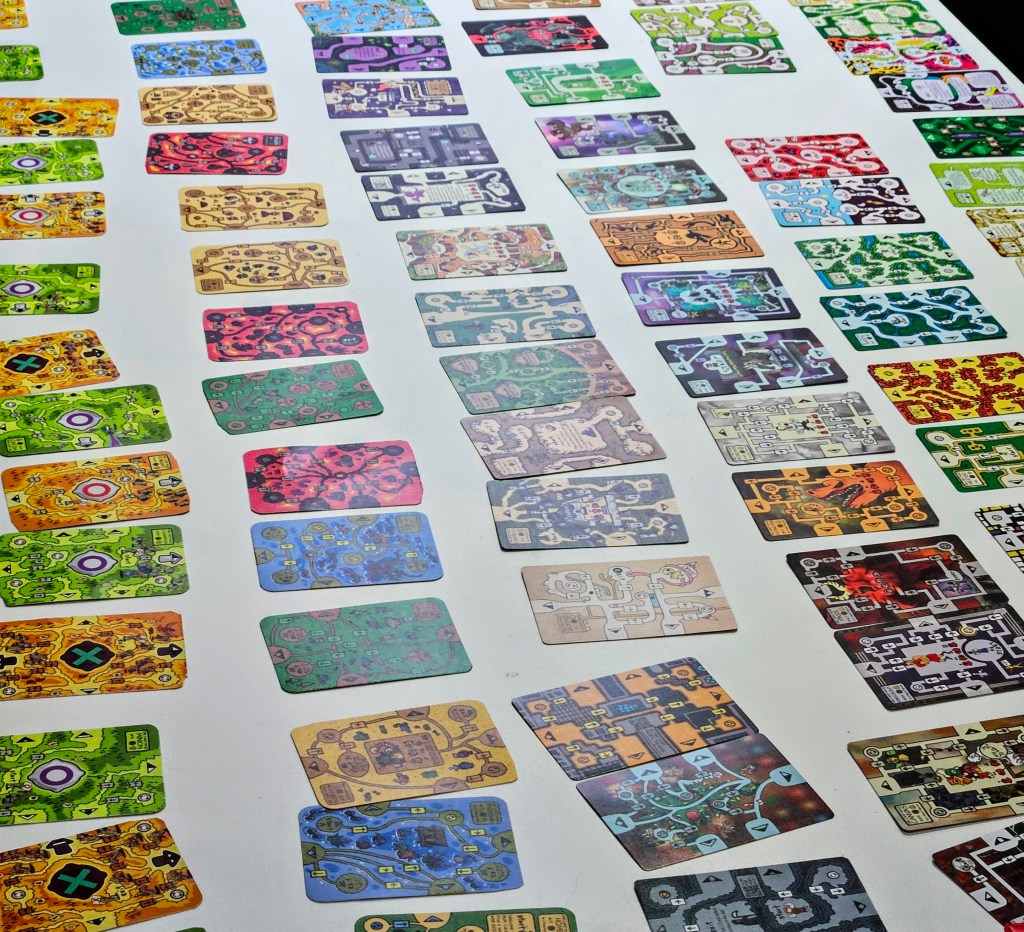
One Card Maze is a simple concept with a pretty impressive execution! As the title suggests, it’s simply a maze on a card. This doesn’t sound that appealing on paper but there are some interesting mechanics that make this a little bit more of a challenging puzzle than a standard maze. When traversing the maze you must maintain its orientation and you will come to doors that you can only pass when holding the card up a certain way. There are other areas of the maze that allow you to rotate the card, and if you reach an edge you can also travel to the other side. It seemed like a fun little puzzle and I’m pretty sure kids would really love this sort of thing. And don’t worry, there isn’t only one One Card Maze, as you can see in this picture, there’s lots! It’s available now from their website!
Scoffton
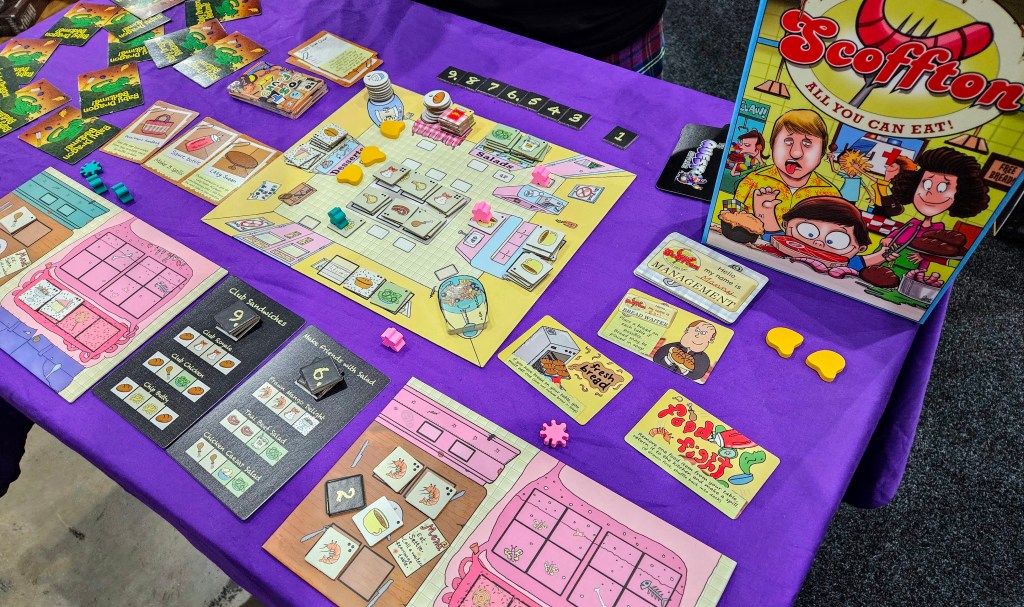
Scoffton is a fun looking game about visiting a ratty 80s all-you-can-eat and trying to get the best bang for your buck by fitting as much food in your stomach as possible. The game revolves around visiting the buffet to harvest foods, tetrising them into your stomach and even includes the option to block spaces on the board with a sneaky takky yak. I really enjoyed the cheeky 80s-90s style cartoon theme and the game is stuffed with fun little references and jokes.
~
I had a great time at PAX as usual, and I really enjoyed discovering all these new and upcoming games. I certainly look forward to following along the ones I liked to see where they go, and of course, wonder what of the many other great games there I missed out on! There’s never enough time to see everything. Thanks for reading!

 The Boardgame Detective