

King Stephen is struggling to control England after fracturing loyalties since snatching the throne many years ago. The lands have become lawless, some may say The Anarchy reigns! With your help the King hopes to crush disloyal strongholds and restore law and order to the lands. Hopefully, your box-ticking strategic and political skills will help bring back Bravery, Loyalty Influence and Might to the King!
1-4 Players | 2 Hours | Designed by Bobby Hill
While The Anarchy is not explicitly named “Hadrian’s Wall 2” (which I personally think would have fit well as Antonine’s wall is pretty much Hadrian’s Wall 2) in most senses this game is a sequel to Hadrian’s Wall. The two games share a core of mechanics while varying in many other places, allowing for familiarity to help returning players onboard quickly and significant changes that make the game an exciting foray both for new and returning players. This review will more or less build upon my review of Hadrian’s Wall so if you would like some context feel free to read that one before continuing!
How does it work?
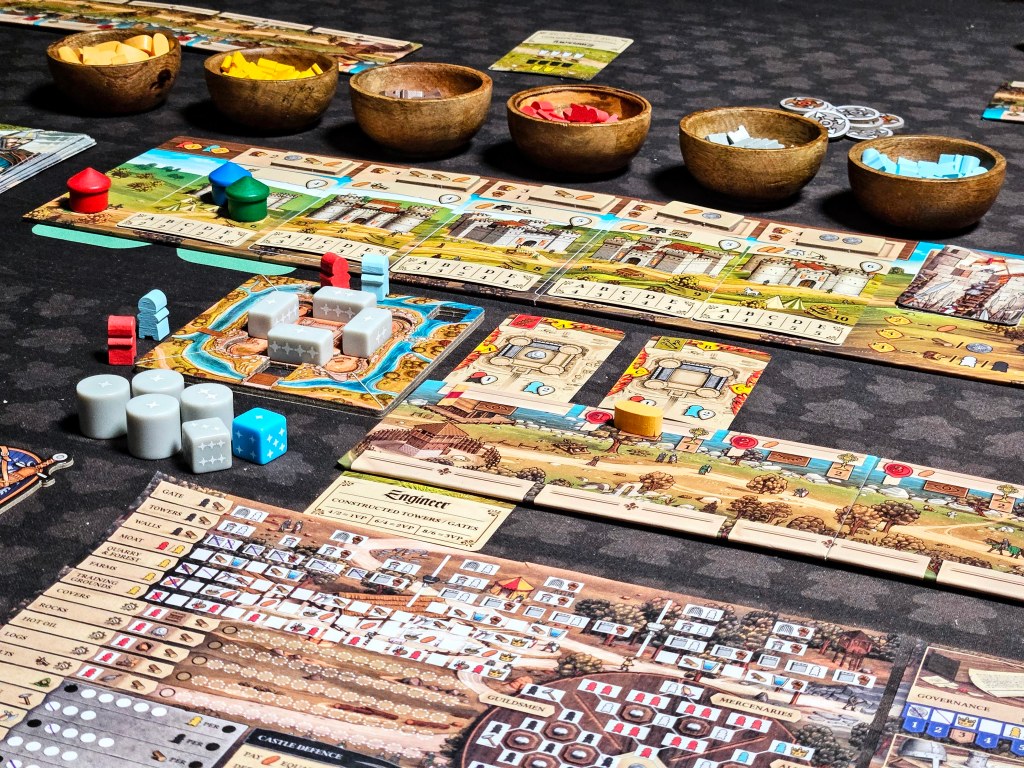
The Anarchy is what I’m going to call a ‘Work(er placement) and Write game’, but really it’s a resource management game where you spend the resources you gain each round to progress a number of tracks, aiming to generate 4 types of points and end up with the highest score after 5 rounds of play.
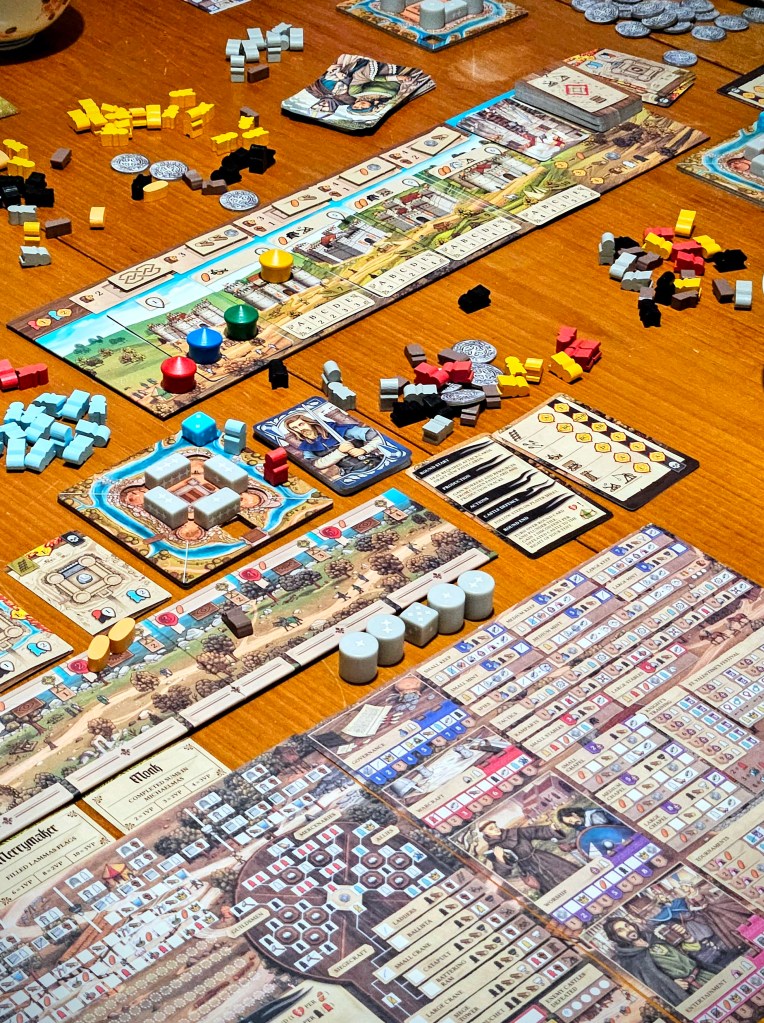
At the beginning of the game each player is issued with two sheets – a castle sheet and a town sheet. Each contains an impressive number of tracks and boxes to be filled on over the course of the game. You will also get a small deck of cards for generating random events, an unconstructed castle and a round/impending attacks board.
Each round players draft a collection of resources to begin with and take their income. You will get a number of each of 4 types of workers along with some wood, bread and money. As the game progresses, you can improve your production and gain more resources to start each round with. From here, gameplay is largely unstructured and independent. To take an action, you essentially pick something on one of your two sheets, pay the indicated cost and fill in a box.
There are MANY options of what you can spend your resources on. On the castle sheet you will be spending builders and soldiers to build up and secure your defences. On the town sheet you will mostly be spending citizens to develop your town and culture. You need to work out where best to spend your resources each round to make sure you are ready for the end of round attack, and part of the puzzle of the game is working out how to take advantage of bonus combos to stretch your resources as far as possible.
At the end of each round, players evaluate their attack cards. If you’ve built up your castle appropriately (you will have some idea of what you will need to defend against but there is some randomness), then you defend and be rewarded with Bravery. If not, then you will gain some discontent which you need to counteract before the end of the game or lose points. After 5 rounds, player tally up their Bravery, Loyalty Influence and Might scores, add on their bonus points, and find out who built the best castle!

What’s new and different from Hadrian’s Wall?
There’s a bunch of changes and additions to The Anarchy. Overall, the game is more complex and longer but if you are familiar with Hadrian’s Wall it’s not a big step to make.
- More resources – There are now wood, bread and coins instead of the previous stone
- Building the castle – You will be building a little castle made out of cool plastic pieces that allow you to upgrade parts of the castle individually.
- The attack system is now specific to each player (everyone gets their own set of attack cards rather than the shared system in Hadrian’s Wall) and has a lot more nuance. You will need to plan based on partial information about what you will be facing, and there are many different ways you can defend against attacks – technology, using soldiers and knights, and building up your castle,
- You are able to use your military tech + army to venture out and attack NPC castles that provide rewards.
- The ‘minigames’ on the town sheet are all powered by your deck of cards,
- Money provides a flexible way to get resources you need and progress through technology upgrades.
What do I think?
I’m not going to drill down here that much because almost all of my comments from Hadrian’s Wall still apply to this game, and you can read those over in my Hadrian’s Wall Review. These are a few observations that are unique to The Anarchy and the changes made between it and Hadrian’s Wall.
The Good Stuff
- The little castle could have been a track but it’s so much cooler to have it be a little actual castle made of pieces, and the pieces reflecting the strength of the castle.
- The new money mechanism gives nice flexibility – you can use money for various different things and it helps “solve problems”.
- I like having some (but not all) indication of what is going to happen at the end of the round as it gives a lot of direction to the player – I can see I need to work on particular parts of my castle or invest in certain defence technologies this round.
- All the card draw driven mini-games are fun and surprisingly different, I’m really impressed by this upgrade to the game.
- I think this game is great as “not an expansion” as it can make more changes, but it still retains the core backbone and familiarity with the original which I like too.
The Bad Stuff
- The new variety of resources (bread/wood/money vs Hadrian’s stone) and the “pick a resource” bonus generates a lot of AP (analysis paralysis). It can be agonising to have to decide which resource to gain each time as you need to look ahead to see what you might need in most cases.
- The game plays quite long – our games were over 2 hours. There are just LOTS of decisions to make. I thought it was fine but I can see it dragging for some players.
- It’s a long rules explanation even with Hadrian’s Wall aware players, and you can’t really “get started and figure it out”, every little area needs some explanation. This isn’t really worse than Hadrian but there’s a few more things to get to.
- The Anarchy has possibly even less player interaction than Hadrian’s Wall. There is no shared attack, and the one ‘interactive’ action is less impactful than Hadrian’s option.
- I would say there is maybe a little less excitement overall in the game as it’s possible to just have perfect information for the end of round attack every time, and even when you don’t have that you have a very good idea of what’s going to happen. I think this issue is two pronged – in the reduced excitement/anticipation, and also it can create the dragging feeling when you know you aren’t going to ‘succeed’ this round and there’s nothing you can do about it.
I was very keen to dig into this one after being a big fan of Hadrian’s Wall. The Anarchy certainly delivers on being Hadrian’s Wall 2. I think if you love Hadrian’s Wall it’s a no brainer to get into this. The real question is what is this game for someone who has never played Hadrian’s Wall? I suppose the questions to ask are – Do you like heavy Euro games? Do you like Roll-and-Write games? Do you love resource management and planning? If you yes-yes-yessed then I would say this game is likely up your alley! If you want to find out more or grab a copy for yourself head over to the Garphill Games Store or keep an eye out at your local game store!
The copy of The Anarchy used for this review was provided to The Boardgame Detective by Garphill Games

 The Boardgame Detective
Good review!
Interesting that that this game and Skara Brae came out at the same time and both of them could be accused of having way too many resource types to manage and choose from.
LikeLiked by 1 person
Thanks! I’m very keen to dig into Skara Brae!
LikeLiked by 1 person