

You’ve been a slave-gardener for as long as you can remember. And now, everything has been thrown into chaos. The Necrodruid, your old master is dead. You’ve escaped, but into what? It’s hard to be sure. Is the world dying or just being reborn? All the other escapees are looking to you as leader – it’s up to you to rebuild your previous citadel prison into a thriving settlement. So off you go searching for what you need to make that happen! Let’s rebuild the 7th Citadel!
This article contains no story or puzzle spoilers! This will be a higher-level overview and review of the game as we don’t want to delve into anything that could spoil the experience for prospective players. Just don’t heavily scrutinise the pictures!
1-4 Players | Lots of hours | Designed by Ludovic Roudy and Bruno Sautter
7th Citadel is the second “7th” game from publisher Serious Poulp, consisting of duo Ludovic Roudy & Bruno Sautter. The pair develops their games together, with Ludovic providing all art and graphic design elements while Bruno works on production and presumably story. 7th Citadel follows the publisher’s previous game 7th Continent in offering a wide, deep, card-based campaign game with hundreds of hours of content. I had a lot of fun exploring the 7th Continent (as you can see here in this post) and so when 7th Citadel came up on Kickstarter in 2020 I was very excited to back the project and see what the team had come up with to follow on from one of my most beloved gaming experiences. 7th Citadel took a long time to make – and it’s understandable when you see how much stuff there is in this game and that it was made by just two people! It arrived this year (2024) in March and I dug in as soon as I got it!
How Does it Work?
The core gameplay mechanics of 7th Citadel are very simple, and actually nearly identical to those of 7th Continent. The game is a co-operative card-based resource management game that includes a form of push your luck as the main mechanic used to resolve challenges in the game. You play through a campaign (‘Threat’) consisting of a number of “short” 1-2 hour-long episodes. Depending on how well you go in each episode, various things will happen to your citadel, good or bad depending on your performance.
At the beginning of a Threat, players set up their citadel via a “tutorial”/introduction scenario. The Threat booklet guides players through this process and then introduces the first real scenario. To play, each player has a deck of action cards, which represent the player’s life force. All actions in the game require players to pass a check (e.g. to craft this item or defeat this enemy, players will need x number of successes). Spending action cards to gain successes to perform actions will reduce the size of the player’s action deck. Cards in the deck are all multi-use, also containing abilities that can be used if the card is in your hand. When the player’s deck runs out, the player spends some of their life points to recharge it. If you run out of life points… you die!
When attempting a challenge, rather than roll a dice to see if they pass a check, players decide how many cards they would like to draw from the action deck (most actions have a minimum number). Each action card has a number of stars on it (0 to 3, including halves). Each star you draw is one success. Say you need two successes for an action. You decide to draw three cards: one has no stars, one has one, and the third has one and a half. You succeeded at that action. This is where the push-your-luck mechanic lies: you do not draw cards until you succeed, you decide in advance how many cards you will draw. There is an obvious trade-off between making success highly likely, and having the deck run out faster, using up your life points.
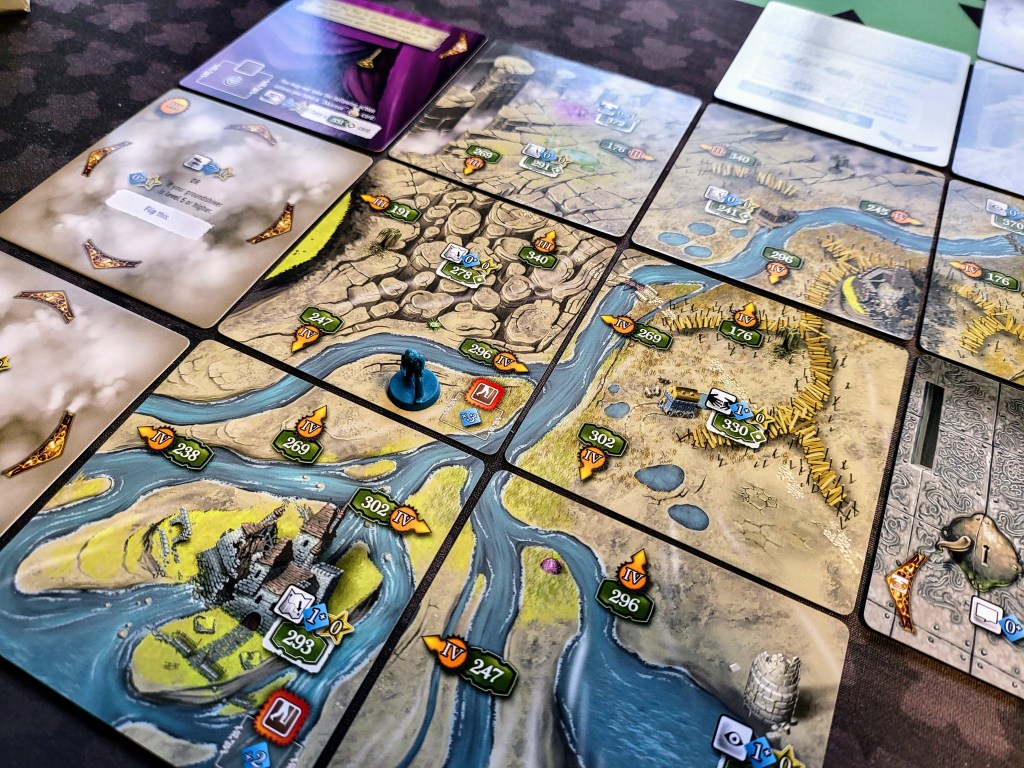
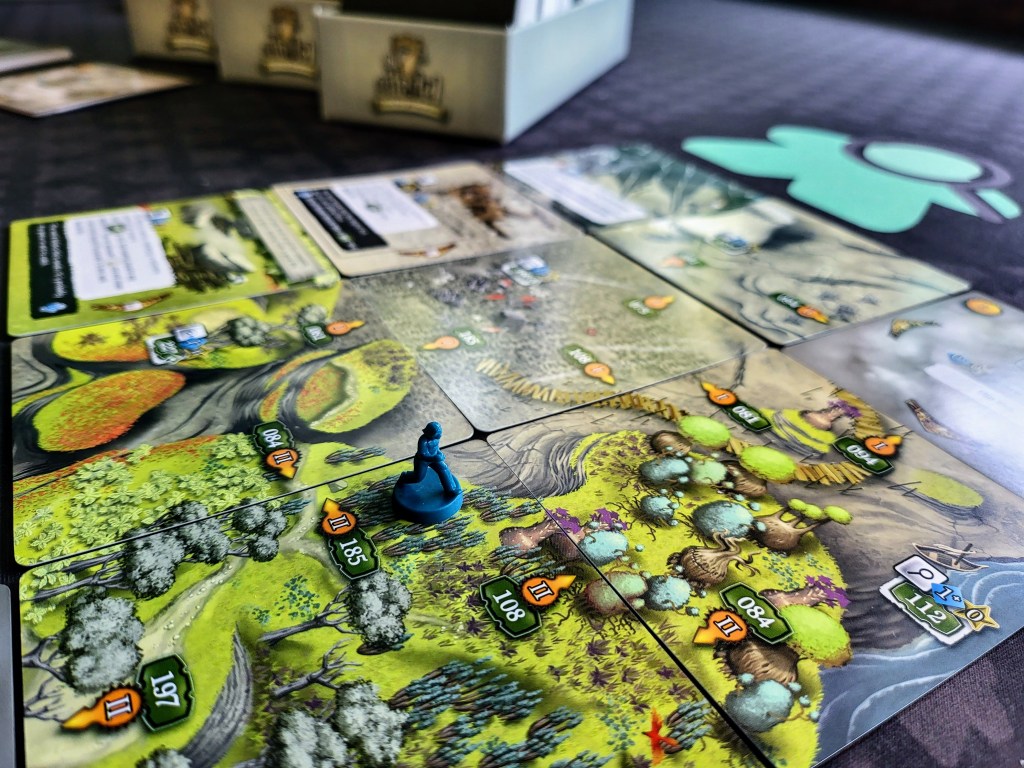
Using this system, players explore a map built up from terrain cards, work toward their scenario goals, and slowly uncover the secrets of the 7th Citadel to try to figure out how to make life better for their community.
So, Let’s Review My Review of 7th Continent
I said above that 7th Continent was one of my most beloved gaming experiences, but that’s not the same as saying it is one of my favourite games. In fact, I had a lot of issues with the game-play mechanics themselves which I will list below for convenience. When I said I loved the experience, what I was talking about was the amazing world-building – the vibrant and real feeling fantasy world the game sat in has so many many details, so many encounters, characters, and little tidbits of lore. It didn’t feel dead and empty like so many game worlds do, because there was something interesting if not a bit mundane around every corner, and little details everywhere that made it feel like an actual world and not just a hallway with the things that the story or game needs to progress. Because of that amazing world-building, I was more than happy to give the publisher another go – even if they delivered a game that was mechanically identical to 7th Continent but with new stuff to explore, that would have been ok. from the Kickstarter page there was a strong indication that they had taken on board what people were asking for as improvements to 7th Continent and that had me excited.
So – what did I say back in 2018 bugged me with 7th Continent?
- The death mechanic (and feeling the need to cheat to avoid death) – this just doesn’t mesh at all with my idea of this sort of experience. I don’t want to have to start my adventure again.
- Slow, grindy gameplay – this was present more so after the first Curse. Possibly this was due to time constraints during development?
- Curses with little to no story – probably similar reasons to above.
- Curses were too long – what’s the value in a 10-hour scenario that could be broken into several smaller pieces?
My Experience
I’ll begin by saying I haven’t nearly come close to finishing the game yet. I have done about 2/3 of the first threat which for me amounts to maybe 12 hours of gameplay (I’m slow, I like to read everything!). I played through the 7th Citadel solo, where I played 7th Continent at 2 players. I found with the significant extra narrative elements I really enjoyed playing the game solo. I like to read fantasy and so this is just like an epic fantasy book, but you choose-your-own-adventure, and it is completely filled with amazing illustrations too. Unlike when I played 7th Continent, I followed the rules of the game to the letter this time. I went into the game fully prepared to bend things like I did while playing 7th Continent, but the game was far more relaxed and I enjoyed it with the rules as written!
There has been a clear reformulation of the previous “Curses” into “Threats”. Threats consist of several much shorter (e.g. 1-2 hour) episodes/chapters. Each one has a narrative introduction and then a set-up sequence, and the objectives and goals for the scenario are clear and engaging, with a solid amount of direction provided to the player. I found this to be so much nicer, especially for someone who is ‘busy’ like me and just wants to break off a small chunk of this at a time.
One of my bigger grievances with 7th Continent, the consequences of death being very severe, seem to actually be made even worse in this game. As far as I can tell, if you die you lose all progress and your whole campaign is over. The good news is, it became quickly apparent when I started to play that dying is extremely hard to do now. You have a very clear and reliable countdown to death, and so far I haven’t come close to being at risk of dying. With the way death works (running out of life points), you can essentially know when you need to turn around and go home, as you can calculate how many life points you will need to get back to the Citadel. I haven’t been stressed at all about dying, it seems to be basically a push-your-luck thing and you can just not push your luck (with regards to going home) in this game.
I love the addition of the world map. It’s such a useful resource and a great mechanic in what it adds to the game. I think the strongest benefit is obviously that it’s great to know where to go for your current campaign as it gives a rough overview of the world. I’m also really enjoying how it’s slowly built up as you play, you have a visual record of where you’ve explored.
In general, as you play through the game and are confronted with choices, I found that there are much milder consequences to failure when you perform actions. I like this! In 7th Continent, you might have been faced with ‘not getting the thing’ if you failed, but in Citadel it feels most often you will get the thing regardless but if you do well it will come with some bonus. Talking about ‘things’ – there are so many more interesting and useful items – and I’m using them, I’m not worried about saving them for the critical moment I’ll need them because stuff is so plentiful here.
Finally, the absolute key thing that has made this game such a fantastic improvement over its predecessor is the massive scaling up of the narrative the game has. There is so much more story, so much more world-building, so much more dialogue, so many more details. There is literally an extra book of dialogue! The game is so immersive and from the first card is instantly alive and breathing. The way the map unfolds feels like there are no ‘edges’ – there is always something sitting over the horizon making the world feel expansive and real and always so many little details making it feel full and vibrant. I am seriously so impressed with how much this game has generated its own “epic fantasy” world to live in.

Has it Been Improved?
Let’s review my complaints from 7th Continent, have they been addressed here:
- The death mechanic ❌- This is still pretty much the same. BUT it’s much harder to die
- Slow, grindy gameplay ✅ – Fixed! Gameplay is focused and directed
- Curses with little to no story ✅ – Every scenario has a goal and narrative
- Curses were too long ✅ – Scenarios are around 1-2 hours long
I am pleased with my decision to jump on board with 7th Citadel. I liked 7th Continent a lot and I am so chuffed that 7th Citadel is a big improvement on top of what was already an impressive game. I am looking forward to more adventures in the Collapsing Lands and if it sounds like your sort of game and you have a chance to play it, go for it!

 The Boardgame Detective