

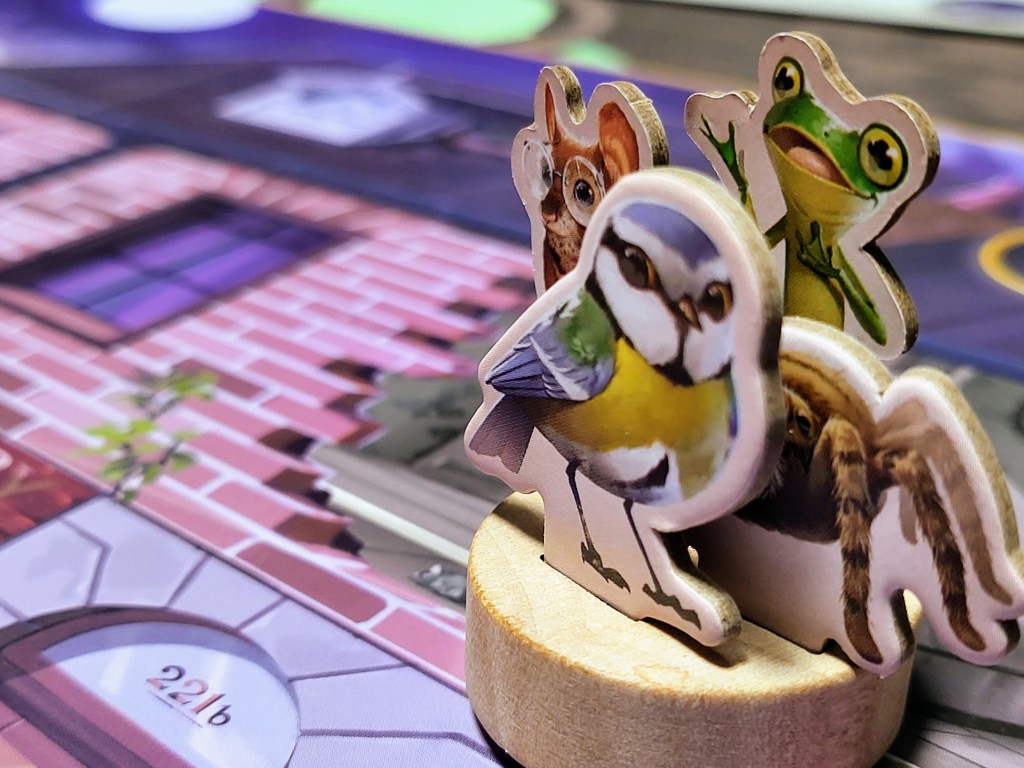
You might find it surprising to learn that Sherlock Holmes wasn’t really that brilliant of a detective after all. In fact, in a manner of speaking, he was more or less 4 small animals in a trenchcoat. Well… not literally. But as we will discover in our adventures with The Animals Of Baker Street, he may have gotten some nudges from time to time from some small hidden friends of his Dog. Are you ready to help these animals solve some (sometimes human and sometimes animal world based) crimes? I am!
1-4 Players | 2 Hours | Designed by Clémentine Beauvais and Dave Neale
The Animals of Baker Street is brought to us by a team of Author and Game Designer. Clémentine Beauvais is an author of young adult and children’s books, along with a book (aimed at adults, I think) about how to write children’s books. Dave Neale is a game designer who has worked on games in the Unlock and Echoes series, as well as a modern set of cases for the original Sherlock Holmes game from 1982. Together they have created a charming game that has a broad audience potential, and delivered a new ‘detective game’ mechanic that could well be expanded with new content, and even used to explore other themes and worlds.
How does it work?
The Animals of Baker Street is a co-operative detective game. Players play through a series of 1-2 hour long ‘cases’ which see them exploring Baker Street gathering information towards figuring out whodunnit. The game gives players a certain amount of time to solve a case, which is represented by clock tokens.
Each turn, players will decide a location to travel to on the game board. It costs a clock to move to a new location, so it’s wise to make an informed decision about where to go based on what you heard in the case introduction or what you learned at previous locations. Once arrived, you read the locations card to discover who or what is there for you to learn from.
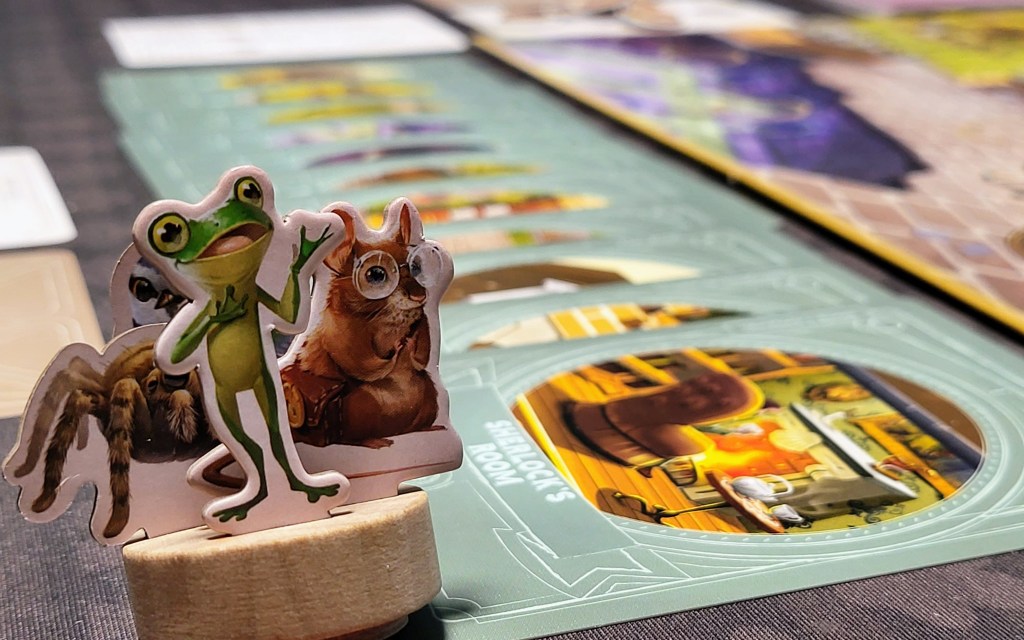
The main mechanic for discovering information in The Animals of Baker Street is a nifty system of matching magnifying glasses. The 4 characters of the detective team each have varied skills. Each character card has some markings on the back side (magnifying glass handles). When you want to attempt to ‘do something’ at a location, you pick a character and line their card up with the locations card. If there are any matching magnifying glass handles something will happen!
If you made a good guess at which character might be useful at this location (e.g., a spider would be good at sneaking around for clues) then you will likely be rewarded with a card draw giving your more info or an item. If you were careless in picking who would be appropriate for the situation, it’s possible to waste some time or even get swiped by some nasty claws!
Players will work their way through the game gathering clues and information, eventually coming to a climax where some combination of items, information and action will ‘solve the case’ and render a victory. Sorry if that description is a bit vague, but I don’t want to spoil any of the cases!
What do I think?
I’ve played through half of the cases now (4), all in 2 player games. I honestly think this game is perfect for two players, but I can see it working well solo or with a larger group. While the game is re-playable in a technical sense (there are no stickers or tearing up cards), knowing the conclusion of a case would make it much less interesting to play again yourself. But the great thing about games like this is sharing them with friends once you are done with them!
The Good Stuff
- The Animals of Baker Street has minimal rules, and is super quick to get into. There are a few key things to know that the rulebook runs you through before you are off solving cases!
- Opening the box I was impressed with the simple cardboard insert – it gives a nice presentation to the game and leads you into the simple and functional design of all the other components.
- Upon first reading how to play, I thought the magnifying class clue system wouldn’t be good … but in practice of works very well and doesn’t succumb to my expected flaw (too easy to remember how things will match up)
- I like the game system, it works really well for this highly story driven game. The narrative, while clearly aimed at children is interesting and engaging for all ages, and not predictable or formulaic either.
- The trade-offs you make when you come to the decision points in the game feel intuitive. A big complaint I have in other similar style games is that you might do something that feels correct with your understanding and the context, but the game takes your choice and something totally unexpected happens. I don’t feel like that ever happened to me in this game.
- I found the stories truly interesting, and there are a bunch of cool reveals, including some moments where special story specific mechanics were introduced. The ‘game engine’ is really flexible and so it feels much more free form than other similar style games.
- This game is packed with cheeky humour. Characters make fun of each other in conversation, the game makes fun of itself, and there are a TON of dad jokes crammed in. It’s all very entertaining.
The Bad Stuff
- This was more-so in the beginning cases, but I got a bit of a linear/on rails feel while playing. While there are choices to be made in the game, often it’s pretty obvious what to do, and when it’s not, making a guess will usually get you back on the beaten path pretty quickly. Maybe this game is just not as ‘advanced level’ like I’m used to. As I said, the later scenarios become much more interesting, with branching etc.
- In my opinion, the time on the box is pretty wrong. There is so much reading to do in this game, and when you are doing it out loud it takes a while! I’m not sure you could finish a case in 45 minutes unless you were speeding through on your own and making very quick decisions. I’m not saying it’s a bad thing the game takes time to play, it doesn’t outstay it’s welcome, I just think the box mis-advertises the time commitment of this one.
- The Animals of Baker Street is a pure co-op, which means you can play it on your own or with up to 4 players (as advised on the box). While there’s no technical reason not to play this with 4 players, I think the best experience is with 2. With 4 you are just spreading the action out thinner.
- A little bit of metagaming possible, and it’s hard to avoid really. In later plays we would sometimes find ourselves eyeballing the magnifying glass positions on a new card to see if it might match some items we got. Thankfully this is harder to (innocently) do with the characters as their magnifying glasses are usually hidden.

Animals of Baker Street is a great narrative experience. It’s one of those games where once you’ve played it you might feel just a little bit sad that you can’t play it again, and then keep it on your shelf because maybe in several years you’ll have forgotten the details and can enjoy it again. It’s clear that it was designed to satisfy a broad target audience. Personally, I’m going to hang on to it so that I can play it with my son (now 3) in a couple of years, I think he will love it!
The copy of The Animals of Baker Street used for this review was provided to The Boardgame Detective by VR Distribution

 The Boardgame Detective