

The Illuminati are here for our books! Oh wait… hmm, just let me put on my glasses.. oh, Illiterati? I see. Well, nevertheless, we take threats to literacy seriously. It seems all we can do, is knuckle down and work hard on reconstructing these lost words to bind back into books before the Illiterati make the whole world illiterate! It would certainly make it harder to write boardgame reviews if that happened, and we can’t have that!
1 – 5 Players | 1 hour | Designed by Gary Alaka, Rob Chew and Jon Kang
Illiterati is the second game from publisher Gap Closer Games (who you might remember from the highly entertaining Rival Restaurants). I was very impressed with the attention to detail of all aspects of their first game – the game design, components, artwork, and especially pun design. As such, I was especially looking forward to checking out their second foray into boardgame production, and intrigued at the idea of a cooperative real time word game. Gap Closer ran a successful Kickstarter campaign in March 2022 and delivered a year later. There are Deluxe and Standard editions available, with the major difference between them being wooden vs cardboard tiles.

How does it work?
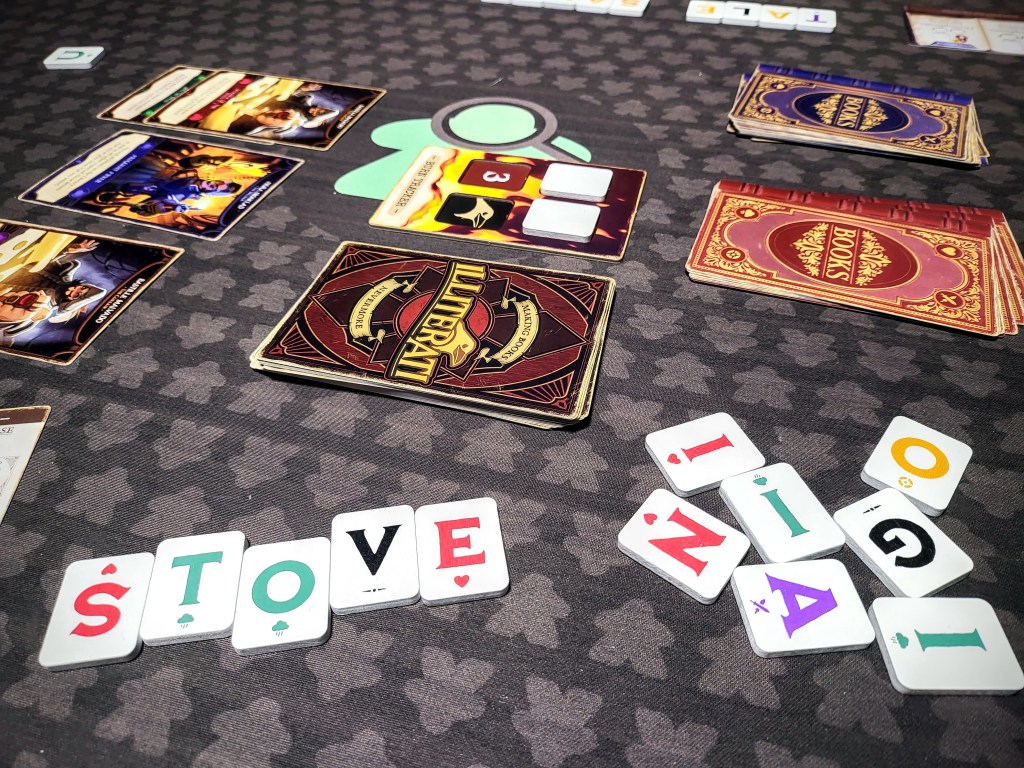
Illiterati is a cooperative word game featuring realtime word building and team based strategic decision making. Players play against the ‘Illiterati‘, who take the form of cards that attack the players in an effort to make it more difficult for them to complete the goal of the game – binding books.
To win a game of Illiterati, each player must bind 2 books before all players attempt and succeed to bind a ‘final boss’ style book. Players start the game with a bunch of letters at their disposal, and in 3 minute rounds, they try to make words out of all the letters.
During the real time word making phase, players are free to share letters and words. The main goal here is just to make everyone’s letters into words. Trying to fit those words into people’s objectives throws another spanner into the works. Letters are kept from round to round, and each player gets some new letters at the start of each round to top up their supply.
At the end of each round, players will check to see if they have bound their books. Books give special conditions for the words that will bind them, e.g. ‘8 letters of sports words’ or ‘two four letter words that rhyme’. At the end of a round, if you’ve bound a book, you discard the associated letters and move on to your next book or wait for the final challenge.
Finally, before moving to the next round the Illiterati attacks, which will cause chaos for players, especially when ‘saving up’ words for objectives. The Illiterati will indiscriminately cull letters and words from unlucky players with their abilities, and as the game goes on they get more powerful, as their effects are compounded as new cards are added to the Illiterati card area.
The game will either end with the players losing – most likely from having leftover letters or invalid words at the end of a round (this adds to the burn tracker, 3 burns and you lose!). To win, players must surmount a big challenge: everyone binding a single book with the same condition on the same round, meaning a variety of words will be needed due to the limited mix of letters.
What do I think?
I’ve played the game a few times with 2 & 5 players. The game is quite different at these two player counts. With 2 players, there is less chaos, but with a limited pool of letters the game is harder. With 5 players, basically any word you need to make should be pretty easy to do, but you need more management skills to keep on top of things during the real-time word forming phase. In terms of play time, I would say it’s about an hour per game, but this can be pretty variable as there are no fixed rounds, or the game can finish pretty early with a loss.
The Good Stuff
- Gap Closer games has gotten two for two now for art and presentation in their games. Everything in this game is beautifully illustrated and the graphic design works well to unify all the elements together. There are a lot of little touches that are very useful and functional too.
- The deluxe edition wooden tiles are amazingly lush! The two bags included with the game are also functional and very deluxe feeling.
- The humour in Illiterati is top notch, and after Rival Restaurants, one of the things I was looking forward to. If you appreciate puns, you will very much enjoy the book names and other jokes here and there within the game too.
- The game-play has a smooth simple flow that is well marked out on the provided reference cards. It’s very easy to teach with a quick example round, and very accessible in terms of complexity level.
- Some letter tiles have suits – this adds an interesting element to the game that is not seen in other similar word+tile games.
- It’s very exciting when a new book comes out – the criteria on them are always unique and interesting and they are fun to discover as you play.
- I think the engine building mechanic for enemy is really innovative. It’s very simple but provides a lot of tension and a very interesting challenge.
- After playing a game, and especially after losing, you get a strong feeling of ‘let’s play this again now!’. This is something I feel pretty rarely (of course, I like to replay games, but rarely immediately).
- The rulebook is generally pretty good, but I spent a little while deciphering a few parts. Everything becomes clear when you actually play through a round and teaching was a breeze after that.
The Bad Stuff
- The real time element of this game means that some players will simply not enjoy it as their skills don’t mesh with the high stress time limited format this game uses.
- My copy included a classic dodgy sand timer. At this point … I almost always have issues with these sand timers, I’m at the stage where I will just pull out my phone and use the timer on that rather than risk the sand timer getting jammed. I don’t think it would be a big issue to stop including these in games…
- The game gets notably easier with more players, it doesn’t really feel like you are playing the same game at all. With two there are a lot of strategic decisions, managing your tiles carefully is important and it’s much more challenging to make complete words, let alone ones that fit your books. In a big game (4,5 players) there are so many letters floating around, if you ‘play right’ it’s pretty easy to make any words you need and to make sure all the letter are used up before each round ends.
- To build on the previous point, the Illiterati themselves are interesting but they feel largely inconsequential in big games. There are so many letters available that when you lose some to attacks it doesn’t really take much out of your capacity to make the words you need, and it’s easier to pick to remove letters you don’t need.
- When playing with my friends, we found it a little hard to be precise with objectives. The game is a coop, and you want to win. There are a fair few books that have pretty subjective criteria, and so we saw a bit of ‘yeaaah I agree that Dota is a sport’ around the table.
- I felt that a few of the mechanics in the game don’t make the most sense in a co-op game. I think the whole concept of the real time word building round would be more fun as a competitive thing – or at least some sort of additional restrictions on tile sharing, in my opinion that made the game a bit too easy in larger games.
- In some games, I noticed there were often rounds where players are just waiting for more letters. We didn’t have much trouble, even on harder modes, to go directly to making words for our books rather than having to settle for ‘any words’. This meant players were regularly just short of the letters needed to meet their criteria, waiting for more options next round.

Illiterati is a fresh and unique game that sits in a great place – it’s fun for gamers, and accessible to people who think of boardgames as ‘Scrabble and Yahtzee‘. I think it’s a great party and family game, suitable for a wide range of ages and ability, something that could be played with oldies and children alike (maybe with some small tweaks e.g. longer time for kids, help with finding words). I love that this game has a personality and would be happy to see it break into the mass market. Word games are very accessible so I think it has a good shot at making it. If you like the idea of playing something like Bananagrams but with objectives, you can find out more or grab a copy at the Gap Closer Games site!

 The Boardgame Detective